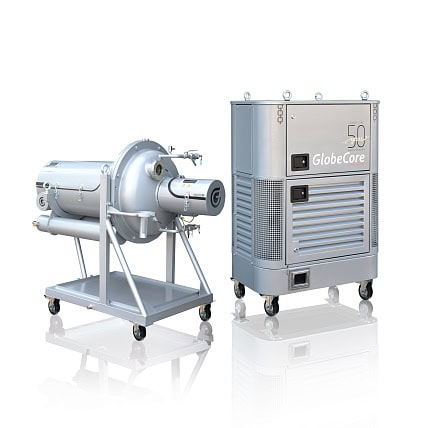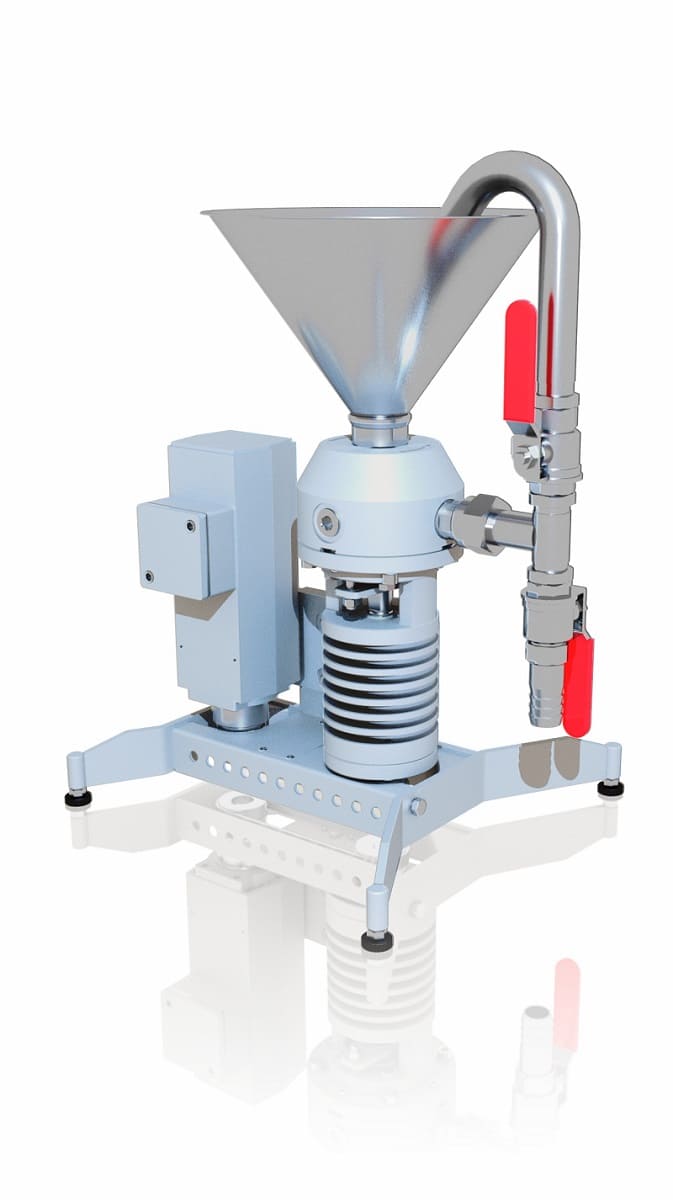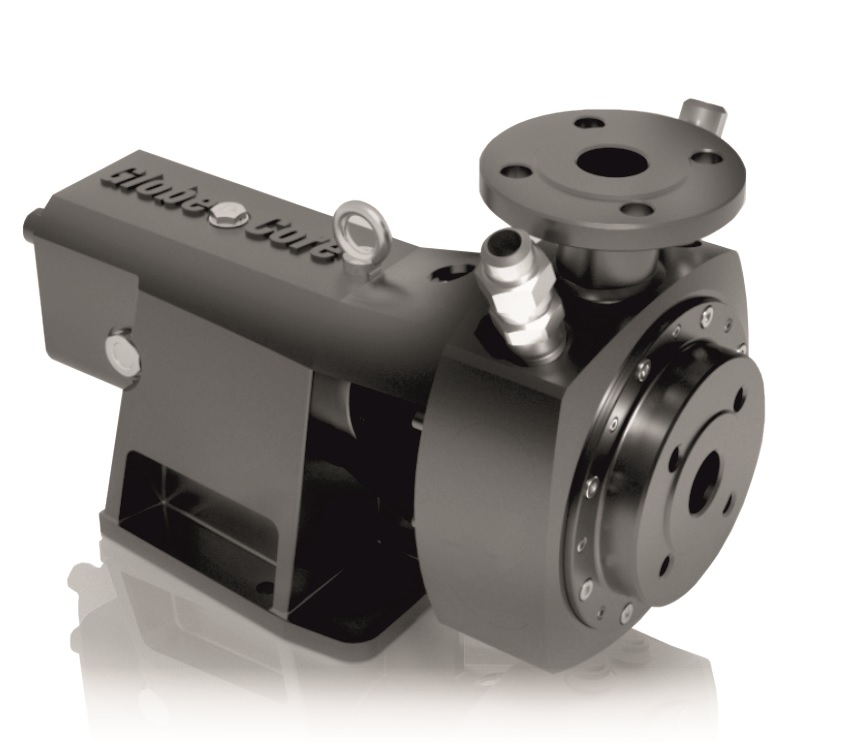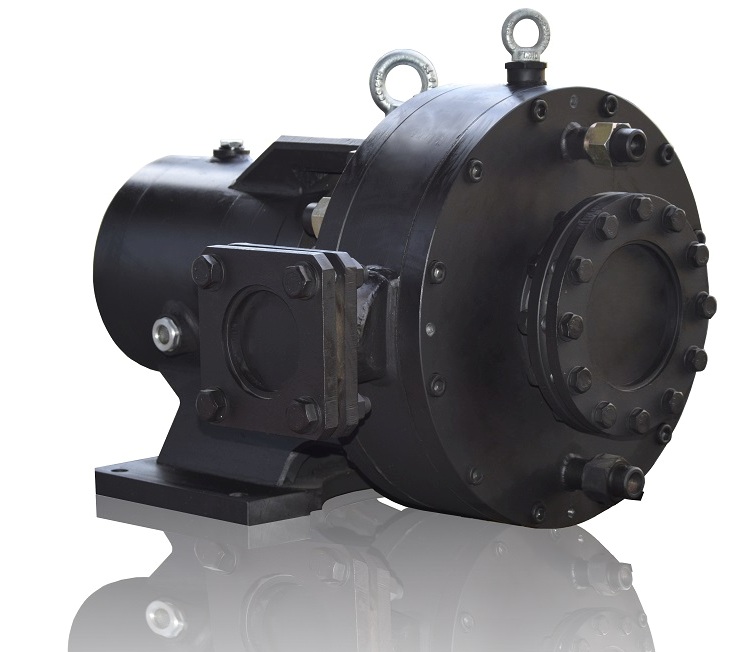
The conditions created in the processing area of the AVS allow to carry out practically any technological processes. The plants are particularly effective in industries that require rapid and uniform mixing (especially if the content of components is calculated in units or percentages) where it is necessary to treat suspensions (heterogeneous systems) regardless of their physical phases (liquid-solid, immiscible liquids, such as: water – black oil fuel, gas – liquid), where it is required to apply the finest (monomolecular) coating films to particles of powders or plant seeds and much more. Any operations can be carried out in a vacuum, in a controlled atmosphere or without any protection at normal pressure and room temperature.
All processes take place in the same processing space, with the same needles and often with the same mode.
The AVS can processes substances in any state, provided that their sizes (for solid phases) correspond to the size of the processing space and needles, the fluids should be sufficiently liquid, and the powders should pour freely.
Until recently, the performance of one machine was relatively small, and in order to ensure, for example, the wastewater neutralization of a large enterprise or city, a couple of the AVS units was required. However, at present, as it has been shown before, the machine for 100-1000 m3 / h have already been designed. They removed all performance problems.
Technological lines equipped with the AVS have a continuous mode of operation. These lines can be closed systems. The specified features of work ensure their high ecological purity.
Water purification
Preparation of drinking water
The problem of drinking water has been actual for a long time. It is still not solved and it is not possible to solve it with traditional technologies in the coming years. Fig. 78 shows the traditional technological scheme for the preparation of drinking water for a large consumer. It consists of a system of filters to treat 4 million m3 , which occupies 20 thousand m2, and a sedimentation tanks for 0.5 million m3 [128]. And worse – it is not specified, where the sediment from sedimentation tanks goes. Such system only cleans from mechanical impurities and disinfects. If the water contains soluble salts, for example, heavy metals, phosphorus or arsenic, the size of the system and its cost grows 2 – 3 times. At the same time, they provide a lower quality of cleaning. But even when the requirements for drinking water are being strict (Table 27) [129], they are not always fulfilled, especially
in remote villages. They take the water, as it was centuries ago, from a river, a lake or even from a pond and use without any cleaning. But times have changed. And if there is somewhere in a vicinity a small tanning factory for treating skins with potassium dichromate, that discharges its waste water without any cleaning into this river. There is no wonder: where the chrome poisoning comes from?
There has been thousands of technologies for the purification of drinking water described, but we will not analyze their work. They perform to some extent, but they don’t entirely provide the required quality of purification. Their common drawback: is the use of diffusion method of substance transfer. This stops the development of sewage treatment plants, since it requires huge investments, which are unlikely to be affordable for many states.
|
Requirements to the quality of drinking water.
|
| Indicators | Measurement unit | Quantitative
indicators
|
| Toxicological: | ||
| – residual aluminum | mg / l | no more 0,5 |
| – beryllium | mg / l | no more 0,0002 |
| – molybdenum | mg / l | no more 0,25 |
| – arsenic | mg / l | no more 0,05 |
| – nitrates | mg / l | no more 45,0 |
| – residual polyacrylamide | mg / l | no more 2,0 |
| – lead | mg / l | no more 0,03 |
| – selenium | mg / l | no more 0,001 |
| -throne | mg / l | no more 7,0 |
| – fluorine for climatic regions I and II | mg / l | no more 1,5 |
| for climatic region III | mg / l | no more 1,2 |
| for climatic region IV | mg / l | no more 0,7 |
| Sensory properties: | ||
| Smell at 200C and when heated to 600C | rate | no more 2,0 |
| – taste at 200С | rate | no more 2,0 |
| – color | degree | no more 20,0 |
| – cloudiness at standard scale | mg / l | no more 1,5 |
| Chemical (affecting the sensory properties of water):: | ||
| – hydrogen index | рН | 6,0-9,0 |
| – iron | mg / l | no more 0,3 |
| – total water hardness | mg / equiv | no more 7,0 |
| – manganese | mg / l | no more 0,1 |
| – copper | mg / l | no more 1,0 |
| – residual pyrophosphates | mg / l | no more 3,5 |
| – sulfates | mg / l | no more 500 |
| – dry residue | mg / l | no more 1000 |
| – chlorides | mg / l | no more 350 |
| – Zink | mg / l | no more 5,0 |
It is difficult to imagine a huge amount of septic tanks, ponds, industrial buildings that will be needed, and a lot of land they will occupy. It becomes clear that new approaches of influencing the substances, other technologies and equipment are needed.
As it was shown above the AVS are able to carry out the kinetic reactions and implementation of various technologies. At the same time, these fantastic speeds of processes (Table 3) are performed at significantly lower capital and energy costs. With this the chemical processes remain almost unchanged, but some physical phenomena undergo changes and are very noticeable.
Using the described phenomena, a new technological line for the purification of drinking water was created with the productivity of 200 – 600 m3 / day shown in Fig. 79. The output of purified water can be increased If necessary by using the AVS of a higher power or a couple of units. This will require larger sedimentation tanks. The purified water can go to the heating network and for feeding boilers. Depending on the initial quality of water and the cleanliness requirements, it can be purified with either hydro-cyclones (sedimentation tanks), or FPZs, or both systems. Fig. 80 shows the plan of the water treatment section, which does not require powerful foundations or big industrial buildings.
In the processing zone of the AVS, shock waves of high power, cavitation phenomena and ultrasound influence the water and impurities in it. The additives used in the process, in the form of Ca (OH) 2, iron sulphites Fe804 and others decompose very rapidly into ions and
enter into reactions with impurities, forming insoluble compounds in the form of metal hydroxides. In addition, water under the influence of these and other factors decomposes into H + and OH ‘ions, which in turn react, forming hydroxides and other compounds. The presence in the water of a high concentration of negative ions leads to the death of microflora, helminths and their eggs. Therefore, the water can be disinfected without the addition of chlorine or added in much smaller amounts.
Reduction of carbonate and non-carbonate water hardness is achieved by adding lime or flue gases, more precisely, its active CO component.
When the water contains fats or oil products they form insoluble calcium soap, which quickly precipitates.
The purification efficiency depends largely on the rate of suspension separation into water and slum. The treatment of suspensions in the processing zone of the AVS leads to an accelerated precipitation of the solid phase (by a factor of 2-5), regardless of whether it was in the solution or introduced from the outside. This phenomenon is explained by the fact (see above) that the solid particles acquire new properties – they lose the “cloud” of H + and OH ‘ions held by Van der Waals forces, and precipitate much faster. In this case the Stokes laws are no longer realized.
High efficiency of water purification with the AVS gives grounds for its use in another way. In most cities there are systems for purification drinking water and wastewater that do not always work with sufficient efficiency. And since the AVS do not occupy large areas and do not require industrial buildings (they are practically mobile), it is advisable to use them at the end of the process for post-treatment, that is, to bring the water composition to the maximum permissible concentrations (MPC). This is especially important in cases of epidemics or epizootic outbreaks.
Also the plants for purification of drinking water, based on traditional technology, are very unprofitable in small villages. The AVS can eliminate many difficulties for reasons indicated above. Fig. 81 shows the production line with a capacity of about 50 m3 / day.
1 – Equalization tank; 2, 11 – pump; 3, 4 – Tanks for additives; 5 – AVS; 6 – middle tank;
7, 8 – sedimentation tank; 9 – Collection tank for clean water; 10- Sludge receiver
With a tank diameter of 2-3 m, the area of the site will be 20 – 25 m2.
Table 28 presents the results of such a site on the Taman Peninsula. The initial water had a brown tint. The analysis showed that the water contained up to 1.5% of iron and the same amount of manganese with addition of humic acids.
Changes in the composition of water after treatment in the AVS
|
№
|
Type of treatment | Characteristics of water | ||||
| color | рН | Water hardness, mg. eq / l | Pe total, mg / l |
Mn,, mg / l |
||
| 1. | Initial water | Brown (tea color) | 6,5 | 2-3 | 1,4 | 1,5 |
| 2. | Treatment in the AVS without additives | Transparent | 6,6 | 2-3 | 0,5 | 0,5 |
| 3. | Treatment in the AVS, with lime additive | Slightly unclear | 7,5-8,5 | 4-5 | Not found | Not found |
| 4. | Treatment in the AVS, with lime additive. Filtration through river sand without settling | Transparent | 7,4-8,5 | 4-5 | not found | Нnot found |
The f filtration can be changed for sedimentation.
To provide a settlement with a population of 1,000 people, it is enough to have 2 machines, of which one is a spare.
The technological line works as follows. First are determined the actual composition of water and the purification regime. The additives for water purification can be lime milk, solutions of soda and iron sulphite (if there is 6-valent chromium)
Turn on the pumps 7, 10, AVS , 6, to supply the water from the tank 1 and the tanks with additives 2, 3. The treatment causes the solution to decompose precipitating calcium carbonate, magnesium carbonate, magnesium hydroxide, chrome, zinc, copper and other metals and calcium soap. The pump 7 supplies the suspension to the hydrocyclone separator 8, in which the bulk of the solid phase is separated and enters as sludge into the receiver 12. Then the water is directed to the polystyrene filter 9, for final purification. This water treatment line can have 2 filters with water passing simultaneously through one or both of them (depending
on the volume of water flow). According to [126], at water speed of about 5 m / h, the continuous operation time of one filter is 40-50 hours, after which the filter requires cleaning and the water flow is switched to the second filter. With the help of pump 10, the clogged filter is rinsed with purified water for about 10 minutes, achieving almost 100% recovery of the filter element 9. Given the high chemical stability of polystyrene against the effects of acids and water, the time of operation of the filter element is calculated in years. The washed particles in the form of sludge are discharged into the sludge receiver 13 provided with a replaceable container. Purified water enters collection tank 14, from which it is sent for “revitalization” or to further purification for boilers.
The second option.
The main difference of this option is the use of lime milk and carbon dioxide (or flue gases) which are waste products, instead of expensive soda,. The gases are fed into the processing chamber by the fan 5. In the working zone of the AVS, carbon dioxide reacts with water, carbonate and non-carbonate components and transfers them partially to an insoluble state, thereby lowering the hardness of the water. The additives of lime and aluminum perform the same functions as in option 1. The difference is that, in contact with water, the water vapor contained in the smoke gases condenses by diluting the original water. It should be noted that the amount of water vapor in flue gases is quite significant: C02 – 9.45%; H20 – 18.9%; TM, – 71.65%. With this we can assume that the condensation of water vapor will be almost complete. Such 1 m 3 of smoke, adds 0.15 m3 of water. The result is practically pure nitrogen discharged into the atmosphere, ensuring an environmentally friendly production.
There might also be a necessity in the reverse process – in saturation of depleted natural water with calcium and magnesium. For this process is used the line shown in Fig. 79. The tanks 2, 3, are filled with the necessary solutions that are gradually supplied into the flow of water that enters the AVS. If necessary the water then goes through cleaning from solid particles in hydrocyclones 8 and filters 9. If the water is free from impurities, cleaning is not required.