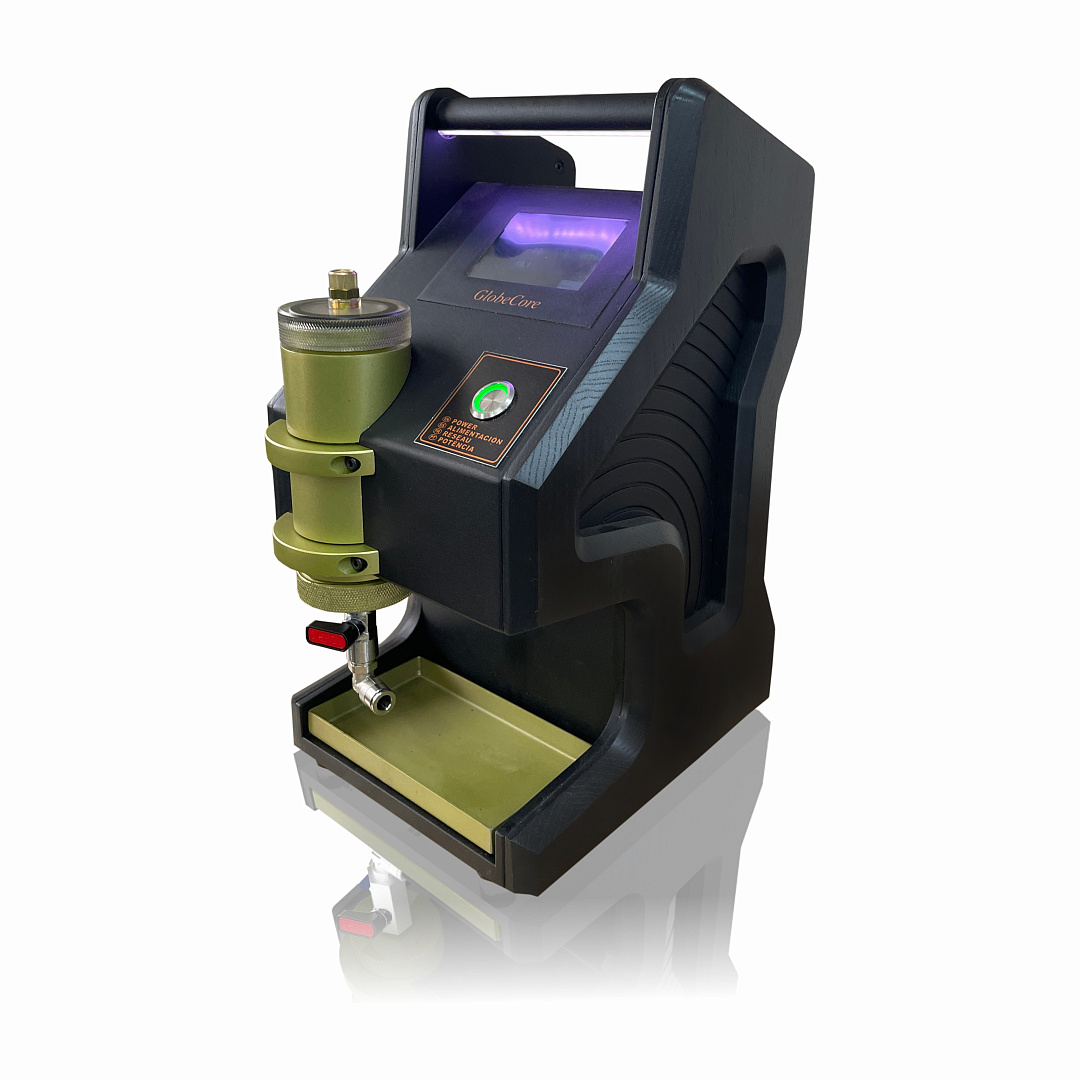
TOR-1 diesel fuel moisture content tester
Moisture content | Temperature measurement | Up to 500 ppm | Small footprint
TOR-1 diesel fuel moisture content tester is designed to detect the mass fraction of dissolved water in diesel fuels.
When operating this device, it is necessary to take into consideration that the tester is only a reference point for fast detection of moisture content; a final analysis requires contacting a certified laboratory.
In the best-case scenario, standard laboratory analyses take a day and require a great input of human and financial resources. The use of TOR-1 allows diagnosing the diesel fuel as soon as possible.
Components of TOR-1 diesel fuel moisture content tester
The device combines all the devices necessary for simple and convenient operation:
- LCD-panel to display the moisture content of tested diesel fuel;
- intake container for tested diesel fuel;
- moisture sensor to detect the mass fraction of moisture in diesel fuels;
- printer for paper output of test results.
Principle of operation
The measurement of moisture in diesel fuel is similar to that of moisture in air. The water content in diesel fuel can be described as an absolute value in ppm or a relative value of aw:
- ppm means the ratio between the weight of water and the weight of diesel fuel;
- aw means the actual moisture content as a percentage of the diesel fuel fully saturated with moisture.
The value aw = 0 stands for moisture-free diesel fuel, while aw = 1 stands for diesel fuel fully saturated with moisture.
The instrument measures aw using a capacitance sensor that ensures a long-term stability and an excellent resistance to contamination. The measured physical quantities include active water (aw) and temperature (T). Using these quantities, the express tester calculates the moisture content (ppm) in diesel fuel. Measured and calculated values are available on two freely scalable and configurable analog outputs.
| No. |
Parameter |
Value |
| 1 | Operating range, active water (aw) |
0…1 |
| 2 | Operating range of dissolved water content measurement, ppm |
0….500 |
| 3 | Precision at 20 °C (68 °F) |
±0.02 aw (0…0.9 aw) ±0.03 aw (0.9…1 aw) |
| 4 | Temperature measurement |
Yes |
| 5 | Operating medium temperature, °С (°F) |
0…55 (32…131) |
| 6 | Required power, W |
10 |
| 7 | Single-phase 50Hz AC power supply voltage, V |
220 |
| 8 | Dimensions, mm (in), max
— length — width — height |
190 (7.5) 255 (10) 365 (14.4) |
| 9 | Weight, kg (lbs), max |
5.9 (13) |
- Сompactness
- Еase of operation: in order to change the sample, it is enough to change the removable container and to press the Start button for starting the measurement.
- Multifunctionality
- It operates without a personal computer.
- It can be used for diesel fuel testing in the field due to a sufficient degree of protection (metal vandal-resistant buttons, sensitive element protection, integrated protection of electrical equipment) and a stabilized power supply.
- The measurement results can be printed out using an integrated printer.
How does the moisture measurement method used in the TOR-1 differ from the Karl Fischer method?
The TOR-1 instrument uses a capacitive sensor that directly measures water activity (aw) and oil temperature. Based on these measurements, the instrument calculates the concentration of dissolved water in ppm. The Karl Fischer method determines water content through a chemical reaction using special reagents. The main advantage of the TOR-1 is its ability to provide rapid measurements without the use of chemical reagents.
Does the TOR-1 need to be reconfigured when switching from one type of fuel to another?
When measuring different petroleum-based fuel, water activity (aw) can be determined without changing the measurement method. However, to accurately calculate the water concentration in ppm, the characteristics of the specific fuel must be taken into account. When switching to non-petroleum-based fuel, the corresponding water solubility parameters must be entered.
Can the TOR-1 be used to monitor the effectiveness of oil drying units?
Yes. The TOR-1 can be used to evaluate the effectiveness of transformer oil drying. To do this, the moisture content of the oil must be measured before and after treatment, and the results compared.
Does the TOR-1 moisture sensor require periodic calibration?
No.


Webinars