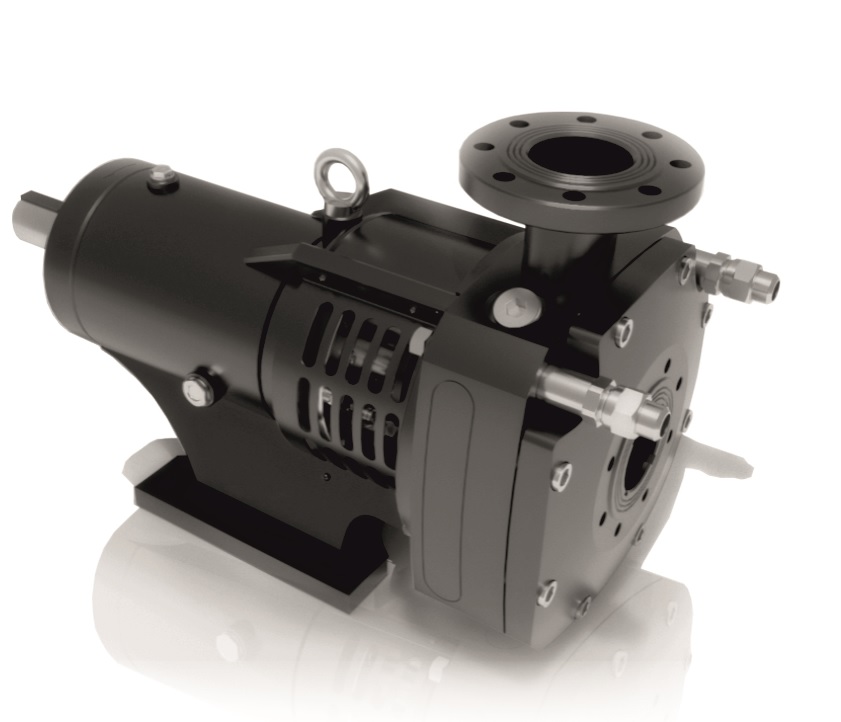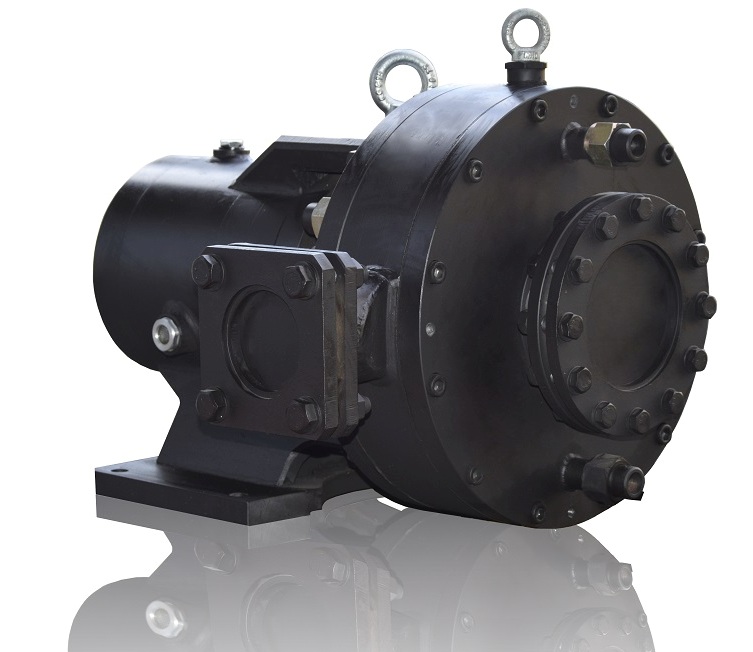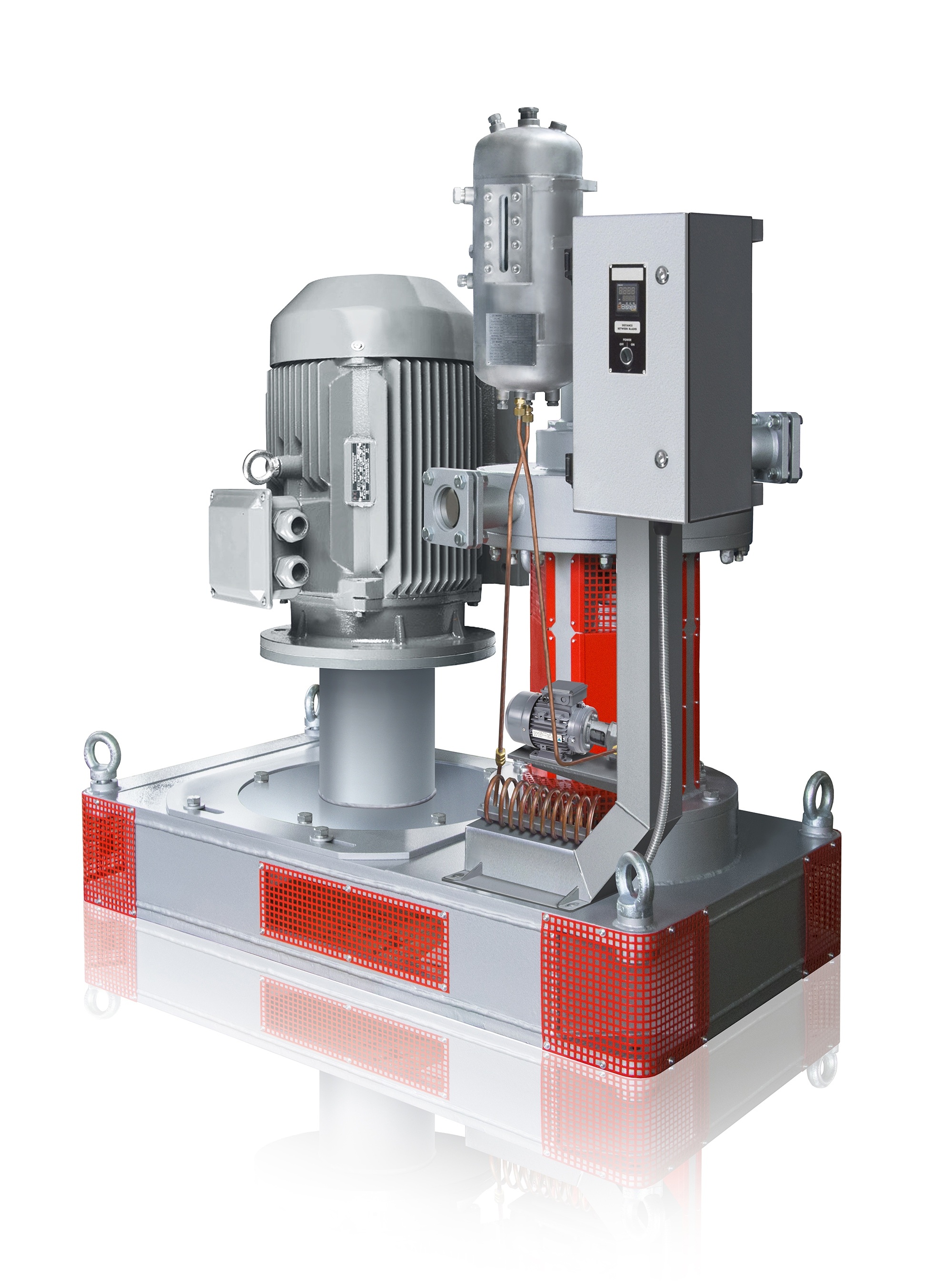
CLM-40.2 Colloid Mill
Cap: 30000 LPH | 5 µm milling | Bitumen modification | Small footprint
Colloid mill1A colloid mill is a machine that is used to reduce the particle size of a solid in suspension in a liquid, or to reduce the droplet size in emulsions. CLM-40.2 is designed for grinding of granules or particles of SBS polymer2Poly (styrene-butadiene-styrene) or SBS, is a hard rubber that’s used to modify asphalt, to make soles of shoes, tire treads, and other places where durability is important. for production of modified bitumen3Modification of bitumen is the incorporation of special additives in bitumen by mechanical mixing or chemical reaction..
The unit may be supplied either as a part of a plant or separately for retrofitting into existing equipment.
The unit is designed for operation either indoors or outdoors under canopy.
The design of the unit allows operation in temperatures from +50С to +400С.
Bituminous grouts — field of application
- Bituminous grouts are classified both by fields of application and by methods of use (cold and hot coating).
- Some grouts require preliminary surface preparation with primers. A primer is a bituminous priming material containing a bitumen and a solvent and having a high penetrability and a short drying time.
- Types of grouts and their uses:
а) Coating grout (cold application):
- waterproofing of surfaces;
- treatment of joints and cracks;
- puttying of surfaces;
- attaching of rolled bitumen materials;
- anticorrosive protection of metal structures.
- b) Coating grout (cold application). It can be used at sub-zero ambient temperatures. It is used for repair and forms an ultrastrong waterproof coating on the steel, concrete, and wood structures sunk deeper into the ground.
с) Bituminous-rubber grout (cold application) is used for waterproofing of foundations, walls, tanks, pipelines, etc.
- d) Adhesive grout (cold application). Designed for attaching the extruded polystyrene to bituminous, bituminous-polymer insulating materials in foundation insulation systems.
Modified bitumen — Fields of application
- Road construction:
- production of asphalt concrete which is used for new construction and repair of first-class roads, bridges, overpasses, road junctions, etc.;
- production of stone matrix asphalt concrete (SMA) for pavement topping of first-class highways and roads;
- production of porous asphalt concrete;
- plaсing of crack-stopping membrane interlayers.
- Hydraulic engineering facilities:
- production of PMB-based grouts for coating of water storage facilities, swimming pools, water supply pipe linings.
- Roofing:
- production of PMB-based rolled roofing materials (Ruberoid, Euroruberoid).
- Bitumen shingles:
- production of grouts for laying and repair of roofing surfaces.
|
Parameter |
Value |
|
| Capacity, m3/h (gpm) |
30 (132) |
|
| Operating pressure, MPa |
0.6 |
|
| Nominal RPM |
3,000* |
|
| Drive power, kW |
110* |
|
| Mean suction/discharge bore diameter, mm (in) |
80/80 (3.1/3.1) |
|
| Heat carrier temperature, ºС (ºF), max |
180 (356) |
|
| Dimensions, mm (in): | ||
| – length |
1,700 (66.9)* |
|
| – width |
900 (35.4)* |
|
| – height |
1,500 (59)* |
|
| Weight, kg (lbs) |
1,150 (2,535)* |
|
| Note.* – the mill is supplied without an electric motor | ||
- Delamination resistance of mixture;
- Adjusted rotor-stator gap without need of disassembling.
What types of processes can be performed using GlobeCore colloid mills?
Preparation, dissolution, wet grinding, and processing of a wide variety of materials, depending on the design features of the working tool.
What types of rotor/stator milling tools are the mills equipped with?
The mills can be equipped with various types of rotor/stator tools, which can be broadly classified into the following categories: nozzle-type, chamber-type, conical (for grinding), conical (for viscous products), or combined configurations.
The type of rotor/stator tool and the number of processing stages (rings) are selected depending on the required intensity of mechanical and thermal treatment of the product.
The tools can be either dismountable or machined from a single solid blank. They can also be manufactured from different grades of steel, depending on the intended application. This allows the optimal tool geometry and material to be selected for each specific processing task.
What types of steel can be used to manufacture the flow-contact parts and components of GlobeCore colloid mills?
The flow-contact parts and components can be manufactured from structural steels, corrosion-resistant stainless steels, and food-grade steels.
Is it possible to adjust the gap between the rotor and stator?
The gap can be either preset or adjustable, typically ranging from 0.2 mm to 2 mm.


Webinars


Production of pharmaceutical emulsions
Bentonite plastic lubricants production
Powder production machine AVS-100

Membranes destruction machine AVS-150