Emulsions are colloidal dispersed systems, where one liquid is dispersed in another in the form of small droplets without mixing. Examples of such emulsions are bitumen or tar and water. The content of bitumen or tar in road construction emulsions can reach 50-65%. Emulsion with bitumen or tar content above 70-75% are referred to as high concentration emulsions.
Viscous emulsions, which include highly concentrated emulsions and emulsion with solid powdered emulsifiers, are referred to as pastes. Emulsions with solid emulsifiers are coarse emulsions. The distributed substance is called the internal or dispersed phase, while the medium in which the droplets are suspended, is called continuous or external phase.
The stability of the emulsion depends on the interfacial tension on the boundary between the internal and external phases. The bigger the difference between the physical properties of the substances, the higher the interfacial tension between the phases, and the lower the stability of the entire system.
Bitumen and tar are very different from water physically, so in most cases, mechanical dispersion of these materials in water does not result in emulsification. The interfacial tension between the phases must be reduced to produce stable bitumen or tar emulsions with water for road construction, i.e. to reduce the difference of interfacial tensions of bitumen and water; this can be achieved by the introduction of emulsifiers. also known as surfactants.
The surfactant is adsorbed on the surfaces of the dispersed droplets of bitumen or tar. reducing the interfacial tension on the boundary between the phases. However, the role of the surfactant is not limited to just that reduction; its main purpose is to form mechanically strong layers on the surface of the internal phase droplets, which prevent the droplets from aggregation.
Formation of emulsion of certain types is defined by the physical and chemical properties of the surfactant, in particular, its ability to selectively interact with the environment. Emulsifiers are classified as hydrophilic or oleophilic. The former selectively interact with water, while the latter interact with bitumen. Hydrophilic emulsifiers form oil in water emulsions (O/W), while oleophilic surfactants form water in oil emulsions (W/O).
In road construction, oil in water emulsion are the most common type. Water in oil emulsions, in combination with oil in water emulsions are used only to achieve better adhesion of the binding material with mineral surfaces.
The chemical properties of the surfactant and its molecular structure have significant effects on the physical and chemical properties of the emulsions. Since emulsifier selectively interacts with bitumen or water, its molecular structure is polar inactive. The emulsifier concentrates at the boundary between phases as a thin film. In oil in water emulsions, the neutral part of the emulsifier molecule is solved in the bitumen phase, while the polar part is solved in the water phase, with which it selectively interacts. The emulsifier molecules required for emulsion formation are surface active. Therefore, the polar “heads” with electric changes are oriented towards the water phase, while the neutral “tails” are oriented towards the oil. Such separation is referred to as interphase or interfacial film, with its properties dependent on the chemical type and the molecular structure of the emulsifier. When the emulsifier is dissolved in water, its molecules can raise to the surface of the water, to its boundary with air, or can form large aggregates, referred to as miscela, which can take disk or cylinder shapes. The surface of these aggregates is formed by the polar “heads”, and the core consists of the neutral “tails”. Such miscela can solve a certain amount of neutral molecules of the oil phase, resulting in the process of solubilization. The surfactant forms protective film around the oil droplets. The size of the surfactant solution particles are many times smaller than that of emulsion droplets, but the nature of these particles are roughly similar.
Chemically, emulsifiers are classified according to different ionization or electrolytic dissociation. Many surfactants are electrolytes and dissociate in water as anions with negative charges and cations with positive charges. The oil-soluble part of the molecule may be located in the anion active zone; such emulsifiers are referred to as anionic or basic, and forms anionic, or basic, emulsions. In the other case, if the active part of the surfactant molecule is positively charged, it is referred to as cationic, and emulsions made with such a surfactant are called cationic or acidic.
A typical emulsifier for the most common basic emulsions are sodium salts of high molecular organic acids. Many bitumens contain a significant amount of high molecular acidic components in the form of asphaltene acids. To make fine emulsions of such bitumen in water, the hot bitumen is mixed with warm solution of a basic emulsifier in the stage of solubilization. Such bitumens with spontaneous emulsification are referred to as emulsifying bitumen. To create emulsions, i.e. finely dispersed systems, it is necessary to reduce the interfacial tension of the water solution below that of bitumen. This is achieved by the introduction of an emulsifier, which reduces this value to zero.
For the purpose of cationic acidic emulsion production, all bitumens are considered non-emulsifying, and require preliminary addition of cationic emulsifiers for spontaneous emulsification. Just as in the case of basic emulsions, these can be made in the simplest machines, such as vane agitators. High molecular amines used as surfactants, can be introduced into bitumen heated to 120°С only if they are sufficiently resistant to heat. The hot bitumen-amine mix is then mixed with acidic water solution (рН up to 5-6) and is heated to 90°С. The positive cation charges are active in this case.
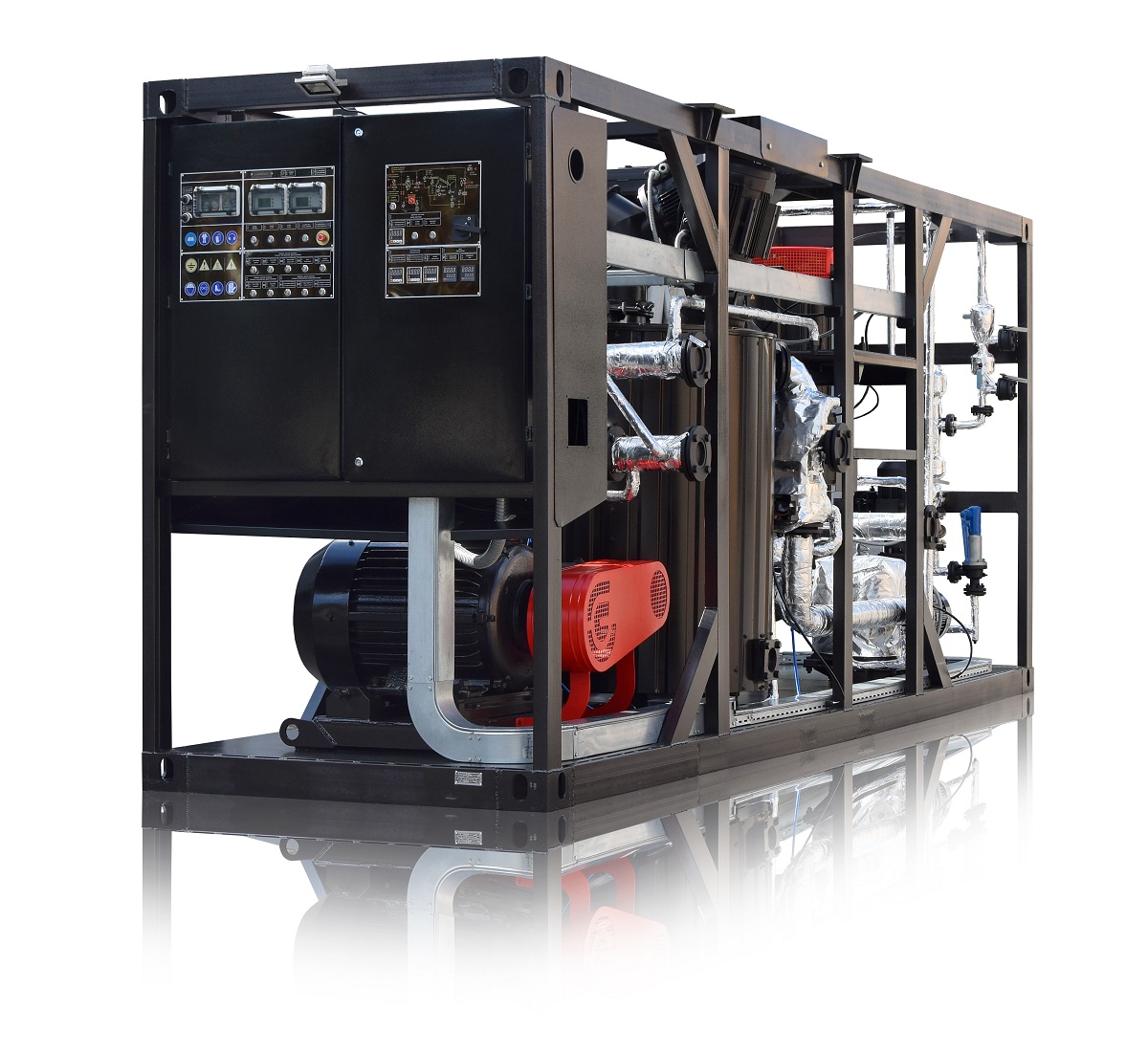
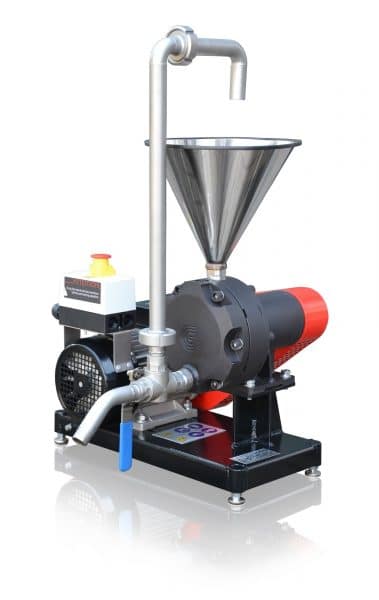
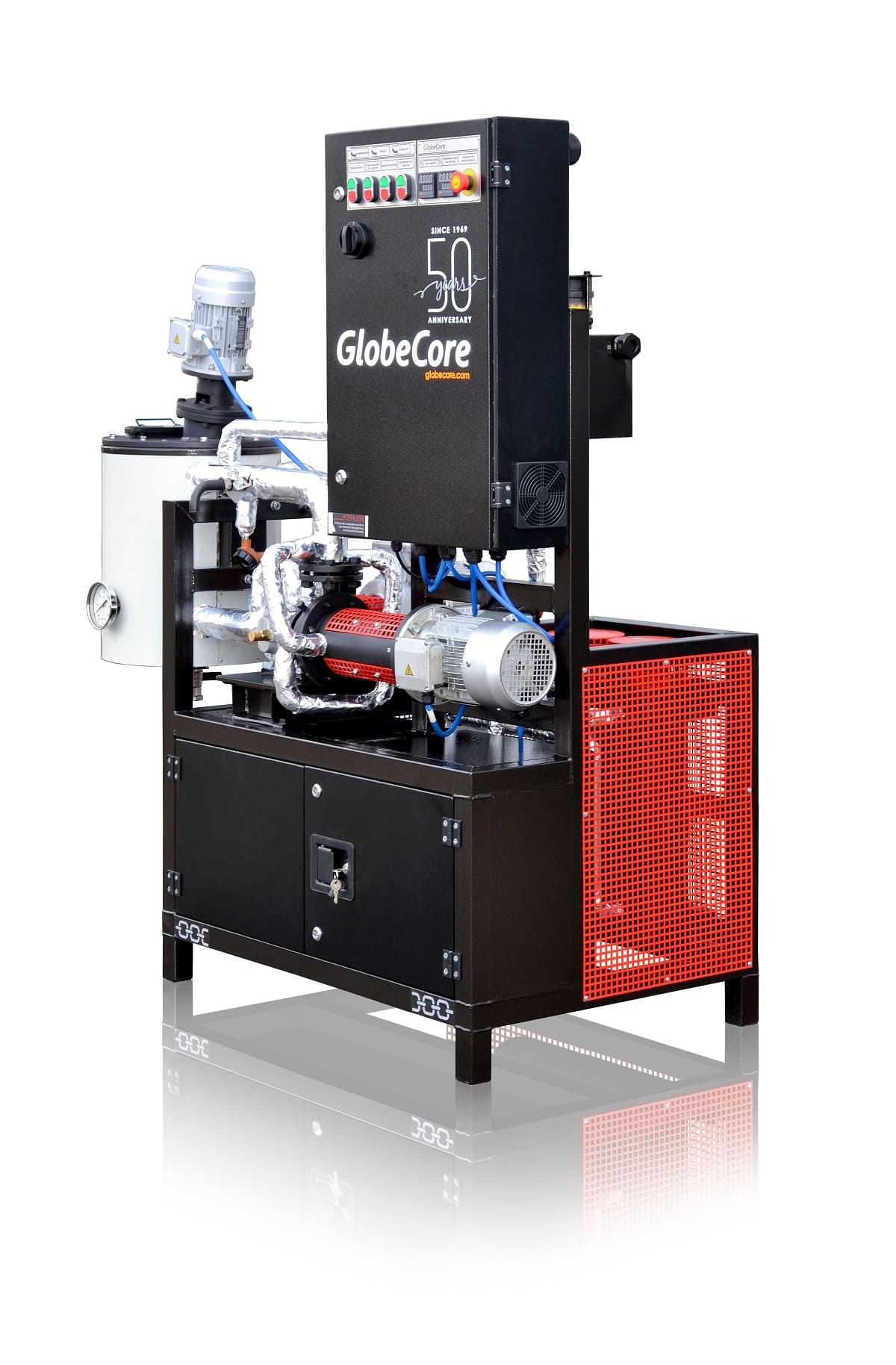
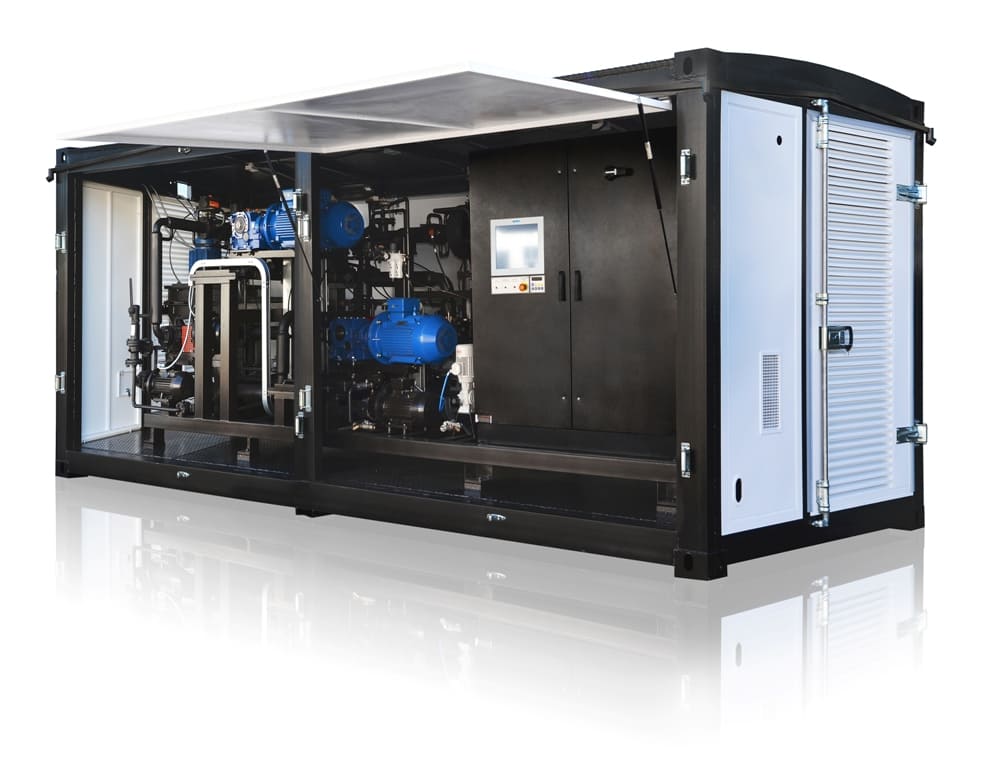
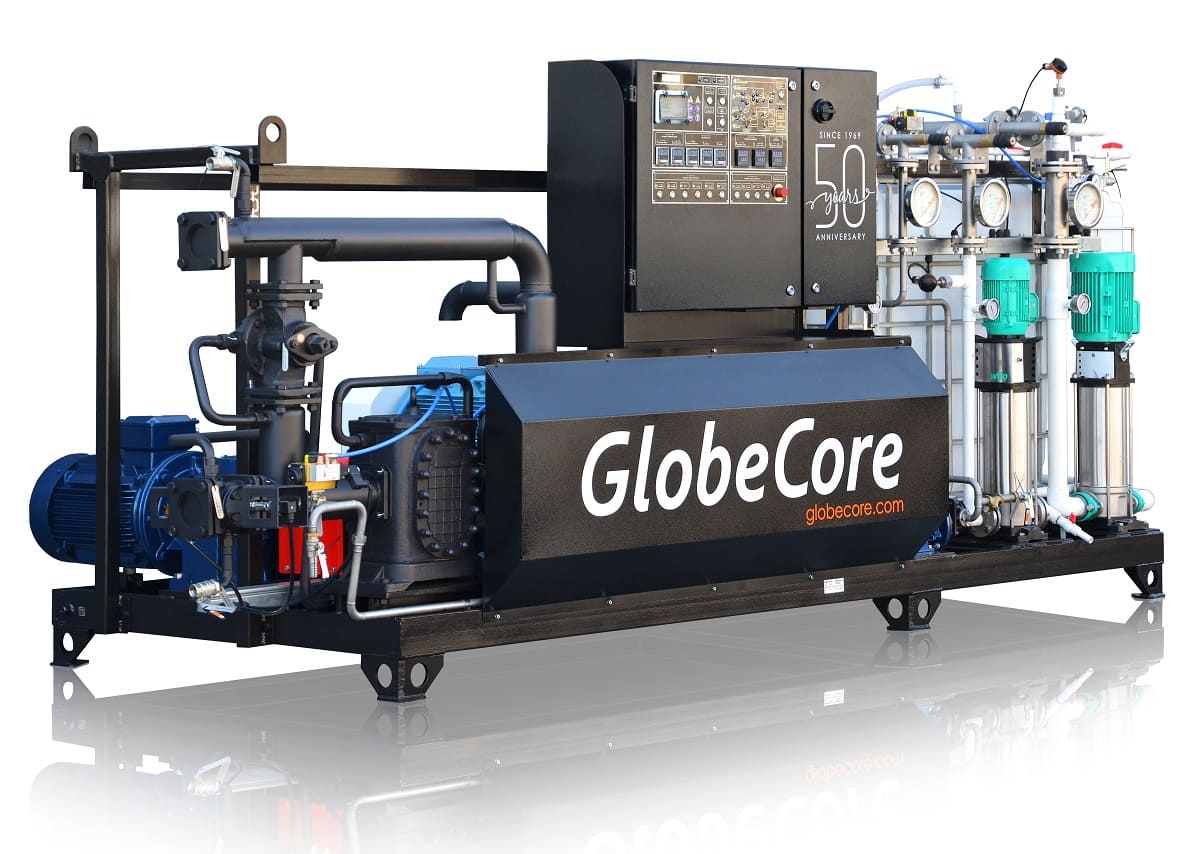
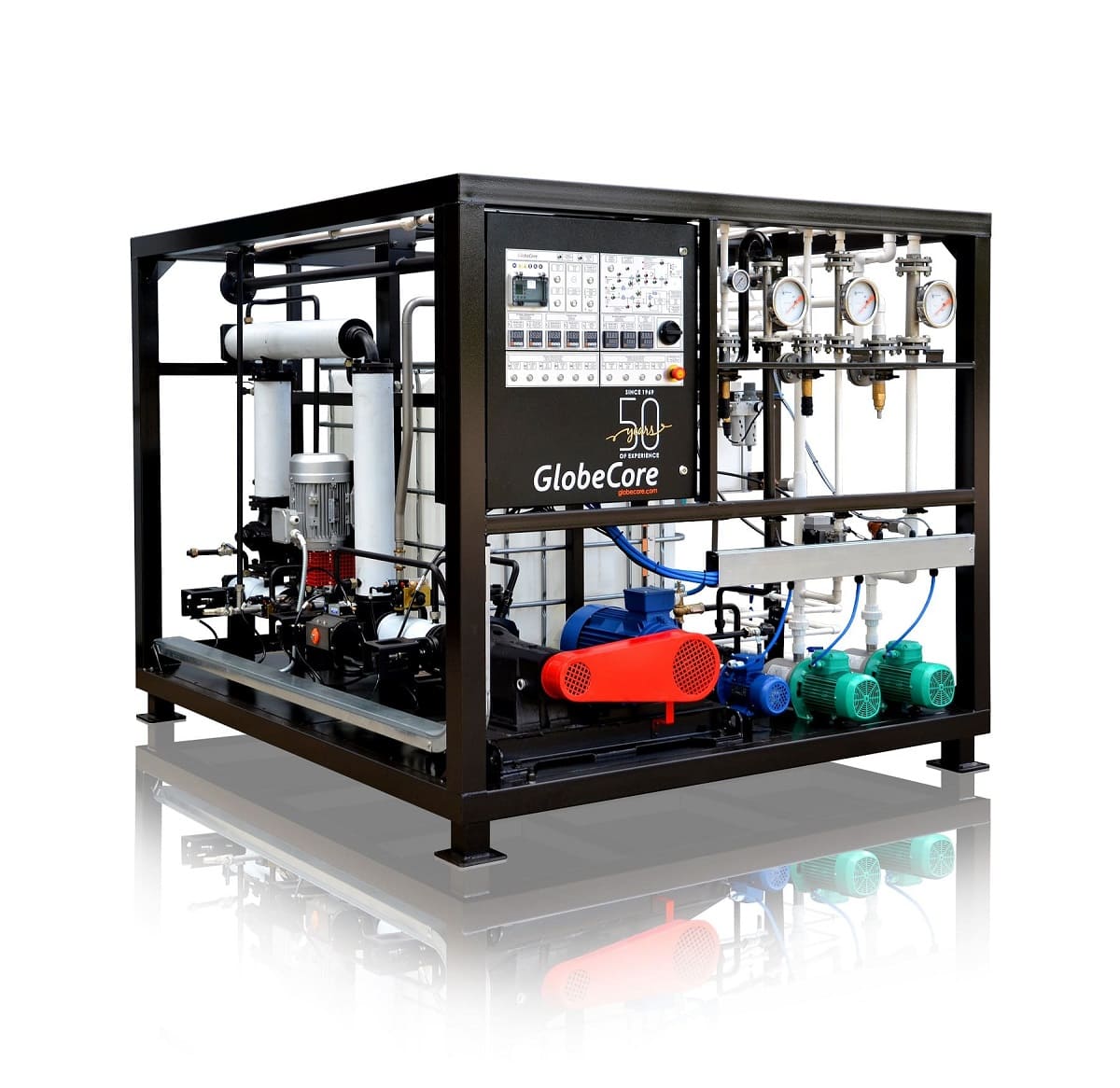
The production of emulsion on industrial scale may involve not only vane agitators, but also colloid mills, which consist of a rapidly rotating rotor inside a stator. A mix consisting of hot bitumen, emulsifier and water is pumped through a narrow (0.2-0.3 mm) gap between the rotor and the stator. Such homogenizer mill breaks bitumen into microscopic droplets, facilitating the correct orientation of emulsifier particles on the boundary between the internal and external phases. In this case, emulsifier can also be introduced into the external phase for acidic emulsions, which results in improved emulsion quality.
The main difference between basic and acidic emulsion is the charge of the emulsified droplets. In anionic emulsion the active surface part carries a negative change, which is surrounded by sodium cations in the basic solution and many layers of water film in the form of hydroxyls. Since the chemical natures of basic and acidic emulsion are different, they must not be mixed. Such a mix would rapidly separate, and bitumen droplets would become free due to neutralization of electrical changes.
Acidic emulsions allow bitumen concentration up to 70% and above, due to the absence of water film around the bitumen droplets; but basic emulsion remain liquid at 18-20°С only if the concentration of bitumen remains below 60%. Acidic emulsion displace the water film on moist mineral surfaces, which allows to perform road construction and repairs in wet weather.
When water evaporates, acidic emulsion ensures strong attachment of bitumen to the mineral material – a benefit compared to basic anionic emulsions.
When mineral surface is treated with bitumen emulsion, the emulsion separates into water and bitumen, which interacts with the surface of the mineral, forming an uninterrupted film. The adhesion of bitumen to the mineral material depends on their chemical nature. Basic mineral materials have active positive charges on their surface. When treated with basic emulsions, the anions of the emulsion droplets are attracted to the cations of the mineral, facilitating adhesion of bitumen to the surface. In the case when the mineral surface is acidic (silica content above 62%), the active anions on the surface repulse the anions of the emulsion, making adhesion impossible. Intermediary minerals with silica content between 50 and 62%, both anions and cations are present on the surface.
When emulsion is applied to lime, dolomite or other minerals, their surface is partially dissolved, and the water phase gains calcium and carbonate ions. Acidity is reduced, and the reaction results in compounds insoluble in water. This makes it possible to use acidic emulsions with lime (silica content over 15%). Basic emulsions are used for treatment of basic or intermediate mineral materials. Thus the range of minerals containing 50-100% of silica, treated with acidic emulsions, is wider than the range of materials (0-62% silica) treated with basic emulsions.
The rate of emulsion breaking depends on the properties of the emulsion and the mineral material, as well as weather conditions. The thickness of the treated layer or base is also relevant.
The main reason for emulsion breaking on contact with mineral materials are the physical and mechanical processes of the emulsion interacting with the mineral, absorption of water by the mineral and evaporation of water when the emulsion and mineral material are mixed and a layer or base is formed.
The surfactants in the emulsion (emulsifier and water) and the low viscosity of the latter ensure good contact with the surfaces of gravel, macadam and ground. Emulsifier is absorbed first, followed by bitumen or tar. Thus, emulsifier molecules virtually bind bitumen to the mineral. Surfactant absorption reduces its concentration in the emulsion, disrupting the integrity of the emulsifier film protecting bitumen droplets, which cases the latter to aggregate. The higher the rate and the amount of surfactant adsorbed by the mineral surface, the faster the water separates from the emulsion.