The existing energy system is heavily dependent on the use of fossil fuels and supports a variety of industrial sectors, such as transportation, manufacturing, agriculture, and others. However, this system is becoming increasingly vulnerable due to a decline in reserves of non-renewable energy sources, an upward rise in prices for them, and the fact that this type of fuel contributes to greenhouse gas emissions that adversely affect human health. Given the growing concern about climate change and the need to reduce greenhouse gas emissions, biodiesel derived from natural sources such as vegetable oils and animal fats serves as a promising alternative to conventional fossil fuels. One of the key advantages of biodiesel is its renewability and lower carbon dioxide emissions compared to conventional diesel fuel.
Biodiesel Composition and Production Challenges
The composition of biodiesel is based on fatty acid methyl esters developed through the alkaline transesterification of vegetable oil or animal fat with methanol. In this case, there develop crude biodiesel and glycerin as resultants of reaction.
The urgent tasks to be addressed in the biodiesel production process include shortening the duration of transesterification process, as it takes a long time in existing reactors, and biodiesel polishing which is normally carried out by water flushing, results in generation of large amounts of wastewater, and oversaturation of the final product with moisture.
GlobeCore Technologies for Biodiesel Production
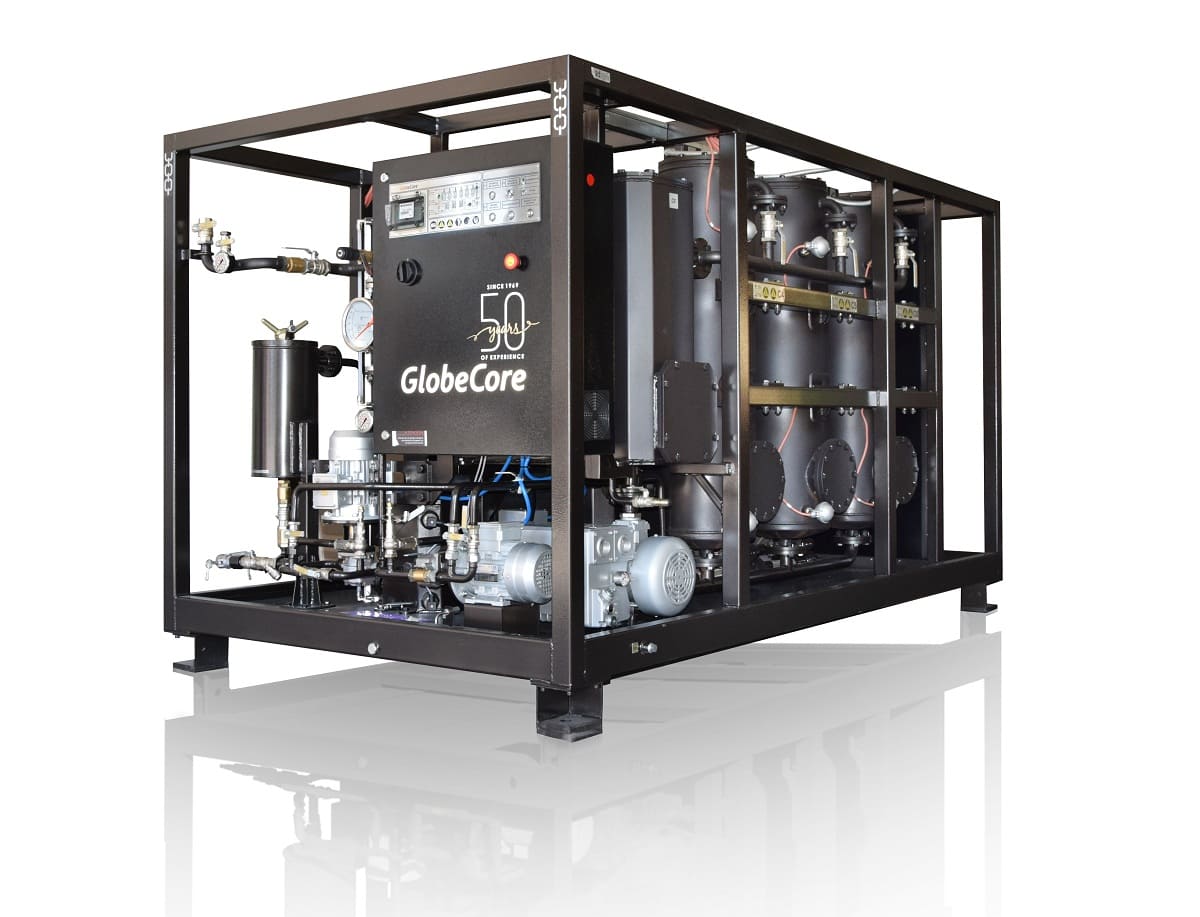
GlobeCore has developed technologies to improve the efficiency of biodiesel production process at the transesterification and polishing stages of the final product. These technologies are implemented in AVS vortex layer devices and CMM-12R plants.
AVS Vortex Layer Devices for Transesterification
The AVS vortex layer devices can be used as a highly efficient transesterification unit due to the fact that a rotating electromagnetic field is created in their operating chamber. Driven by this field, ferromagnetic particles begin to move inside the operating chamber along complex trajectories and constantly collide with one another, with the operating chamber walls, and with particles of processed matter. Direct impact, electromagnetic treatment, and cavitation that occurs in the operating chamber of the device, cause intensive microdispersed blending due to which the transesterification reaction lasts just for a few seconds. As you can see, unlike the existing reactors, transesterification in AVS runs fast and requires no acceleration by adding excess methanol, which then needs to be removed using auxiliary equipment.
CMM-12R Plants for Biodiesel Polishing
The CMM-12R plants are used for biodiesel polishing to remove the impurities contained. Purification in the CMM-12R plants is performed by running biodiesel through twelve columns filled with Fuller’s earth adsorbent. During this time, the adsorbent absorbs impurities from biodiesel and reliably retains them in its granules. In particular, this reduces the level of sulfur, which allows obtaining a high-quality final product at the outlet.
The main advantage of the CMM-12R plant is the possibility of adsorbent regeneration after its saturation. Usually, in such cases, the adsorbent has to be disposed of and changed for a new one; however, in the CMM-12R plants, the adsorbent reactivation occurs directly in the columns where the adsorbent is restored to its initial state. This makes a biodiesel polishing plant easier to maintain and reduces financial costs by eliminating the need to dispose of and change the adsorbent.