

Diesel purification
How can Diesel Fuel Purification Systems Optimization enhance fuel quality?
- This topic has 3 replies, 4 voices, and was last updated 3 weeks, 5 days ago by .
Answers
-
October 5, 2024 at 6:44 am by Emily Jones
Optimizing Diesel Fuel Purification Systems enhances fuel quality by ensuring that the purification processes are tailored to effectively remove contaminants and maintain consistent fuel standards. Flow Rate Adjustment ensures that fuel passes through filters at optimal speeds, maximizing contaminant capture without causing pressure drops. Filter Selection and Configuration involves choosing the appropriate types and grades of filters for specific contaminants, ensuring comprehensive removal of particulates, water, and chemicals. Temperature Control optimizes fuel viscosity and separation efficiency, enhancing the effectiveness of filtration and moisture removal. Automated Monitoring and Control systems use real-time data to dynamically adjust purification parameters, maintaining consistent fuel quality even with varying contamination levels. Regular Maintenance and Calibration of purification components prevent clogging and ensure that filters and separators function at peak efficiency. Energy Efficiency Optimization reduces power consumption while maintaining high purification standards, making the system more sustainable and cost-effective. Integration of Advanced Technologies such as multi-stage filtration, magnetic separation, and coalescing filters ensures thorough purification. Data Analytics and Feedback Loops provide insights into system performance, allowing for continuous improvements and proactive adjustments. By implementing these optimization strategies, Diesel Fuel Purification Systems deliver higher fuel purity, protect engine components, improve combustion efficiency, and extend the lifespan of diesel engines, ensuring reliable and efficient operation.
-
March 5, 2026 at 10:35 am by Craig Price
Another aspect that can significantly enhance fuel quality through optimization is the proper combination of purification methods rather than relying on a single technology. In practice, diesel fuel often contains different types of contaminants at the same time — solid particles, water, and chemical degradation products. Systems designed with multiple treatment stages can address these contaminants more effectively because each stage targets a specific type of impurity. For example, filtration may remove coarse particles, while separation or adsorption processes deal with water and fine contaminants.
Such multi-method configurations improve the overall efficiency of purification and help maintain stable fuel properties during fuel storage and use. Studies of fuel treatment technologies show that combining several purification techniques can produce a cumulative effect, achieving higher purification performance than when a single method is applied.
In this regard, modern optimization strategies often focus on selecting the right combination of purification technologies depending on the contamination level and the required fuel quality standards.
If you would like to explore in greater detail how different fuel purification methods work and why they are often used together in modern systems, this article provides a helpful overview:
https://globecore.com/fuel-processing/fuel-purification/. -
March 5, 2026 at 10:41 am by Linda Jackson
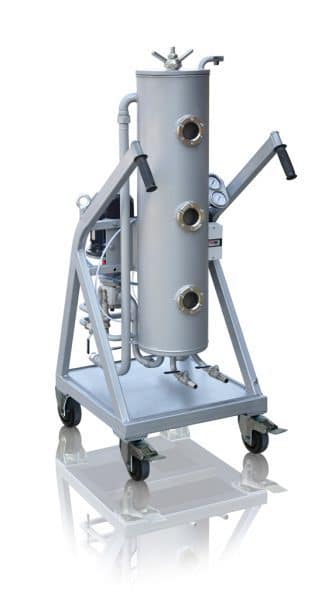
You’re absolutely right: combining complementary purification methods is far more effective than any single technology because each stage targets a different class of contaminants. In practice a robust workflow starts with mechanical pre-filtration to remove coarse solids, proceeds to coalescing/dehydration to strip free and emulsified water, and finishes with adsorption polishing to remove asphalt-resinous products, unsaturated/aromatic hydrocarbons and sulfur- or nitrogen-bearing compounds. In field practice this looks like a CMM-4.0F-style pre-filter, followed by a CMM-1CF-type coalescer/dehydrator (effective even on heavily watered fuel), and an adsorption-polishing train such as a six-column CMM-6RL to restore color, group composition and performance—while moisture checks (TOR-1 or similar) guide when to run dehydration or polishing.
Operational optimization focuses on matching flow rate and residence time to contamination level, using automated control and real‑time moisture/quality monitoring to avoid overloading stages, and planning adsorbent regeneration (thermal reactivation) rather than frequent replacement to reduce consumable cost. Design choices such as all-electric automation, two-stage exhaust neutralization for reactivation, and appropriate sizing (polishing capacities on the order of tens of m³/h depending on feed quality) make multi-stage systems practical at depots and terminals. The result is more stable fuel properties in storage and greater reliability and economy in downstream engine use.