REMOVING IMPURITIES FROM FUEL
Fuel Purification is a process mandatory after long term storage or contact with air.
There are many methods of removing water and particulate matter from motor fuels. The most common methods are settling, centrifugation and filtration. Of course, all processes have both advantages and limitation, and research into the development of new physical and chemical methods of fuel purification is ongoing. The methods can formally be divided into two groups: single use or long term.
The former involve pre-treatment of fuel. In general case, the processing includes washing the fuel with hot water or steam. Water is used because of its surfactant qualities, which can extract most impurities at the fuel-water phase boundary. At the same time, special demulsifiers must be used to completely and rapidly remove water from the fuel after washing. This method cannot completely purify the liquid. Only 3 – 15 micron particles can be removed, leaving 1-2 micron contaminants.
There are other processes, such as the hydrodynamic method. In this case, fuel is pushed through a conical valve at 21-35 MPa. Pressure is gradually reduced almost to normal atmospheric. The change of fuel flow speed and pressure in the valve causes destruction of asphalt and tar substances. The limitation of this method is that inorganic solid impurities are not destroyed. The amount of contaminants in the fuel is not reduced, but dispersed more finely. This allows to protect filters, fuel lines and nozzles from clogging.
Another way to purify fuel is by short sound waves. In this case, the particles increase in size due to acoustic coagulation. They can then be filtered out.
Electric separation can also purify fuel. The electrical field in these systems causes coagulation of water droplets for later removal by gravity or centrifuges.
One time physical and chemical methods of removing water from fuel are efficient, but also complicated and cumbersome. They involve filtration through adsorbents (charcoal, zeolite, silica or alumina gels).
Long term physical and chemical methods are simpler. They ensure adequte fuel purity during transportation, storage and use. The idea is to introduce small amounts of chemically active additives. Their influence remains from the moment of mixing to combustion in the cylinder. The range of additive effects is quite wide. They limit or eliminate corrosion of metal parts, prevent formation of tar, coagulate particulate matter etc. Selection of a specific method directly depends on the requires to motor systems.
Several general indications are reasonably used to estimate fuel purity, characterizing the impact on equipment operation. Some of the indications are maximum impurity size and moisture content. In most cases, equipment manuals contain information on the required purity of the fuel entering the system. Moreover, purity is regulated all along the fuel chain of supply, beginning with the producers and ending with the fuel tanks. Naturally, the highest purity is required when fuel is poured into the tanks.
Table 1 lists all basic fuel purity requirements, obtained by generalization of data in regulatory documents and research results.
Table 1
FUEL PURITY REQUIREMENTS
| Parameter | Motor Gasoline | Diesel fuel |
| Max impurity size, μm | 10 | 5 |
| Content by weight, %: | ||
| impurities, max | 0.0005 | 0.0005 |
| water | – | <.003 |
| particles | – | – |
| Ash, % | Not regulated | 0.01 |
| Preformed gum, mg per 100 ml | 7.15 | 30.40 |
The quality parameters of the fuel may change depending on the impurities and depend more on storage, transportation, filling and the environment, rather than on the properties of the oil product.
The main sources of contamination are:
- Impurities from the air;
- Formation of corrosion products and insoluble substances due to oxidation;
- Pumping fuel through contaminated pipelines;
- Accumulation of impurities in the bottoms of tanks;
- Poor condition of filling devices and hoses;
- Open air filling;
- Poor condition of fittings, gaskets etc.
TYPES OF FUEL CONTAMINATION
Fuel impurities come in all aggregate states: solid, liquid or gaseous.
Solid impurities are mainly the products of wear, corrosion, condensation of unstable hydrocarbons and dust from the atmosphere, roads or other sources.
Liquid contaminants are mostly water, gums and surfactants. Gaseous contaminants are air and other gases.
Did you know that first nozzles were designed by V.G. Shukhov, and the heavy oil was used as fuel?
Impurities can also be grouped by chemical composition: inorganic (mineral substances, water, air) and organic (hydrocarbons).
Another common classification is based on the origins of the fuel. According to that classification, impurities may originate from:
- Manufacturing;
- Processing;
- Operation.
The classifications are instrumental in developing high quality methods of fuel purification by looking at the causes and origins of contamination and preventing it.
SOURCES OF CONTAMINATION
In generally, the causes and origins of contamination may be divided into three stages:
- Receiving fuel, contaminated by corrosion products, soaps, dust and crude oil impurities, from oil refineries.
- Contamination of fuel with atmospheric dust and corrosion products during transportation in railroad and truck tanks.
- Contamination with residues, pump wear products, dust and product of corrosion in filling stations.
Regardless of contamination origins, fuel must be purified to meet quality requirements before being used in the fuel system. At this stage, it is important to select the correct equipment, which must comply with several conditions. One of the main criteria is versatility, that is, the capability to remove as many types of impurities from the fuel as possible, as well as the ability to process various types of fuel without the need for significant refitting of the equipment.
MAIN FUEL PURIFICATION METHODS
Many methods are available today to purify fuel, removing water and particulate matter. Some of the most widely used are setting, centrifuging and filtration. All methods, of course, have both advantages and limitations, therefore research into the development of new physical and chemical fuel purification techniques is ongoing. The methods can be formally divided into single and long-term actions.
The former involve pretreatment of fuel. In general, the treatment is performed by washing the fuel with hot water or steam. Using water is dictated by its qualities: a surface active substances which can extract most impurities from the fuel-water phase boundary. On the other hand, to quickly and completely remove water after washing, special demulsifiers are required. Such purification cannot guarantee complete removal of impurities. Only 3 to 15 micron particles can be remove, with 1 – 2 micron impurities remaining in the fuel.
Naval vessels were converted from coal to oil fuel after suggestion by Dmitry Mendeleyev in 1887.
The above method is by no means the only one. There is also the hydrodynamic processing. Fuel passes through a special conical valve at 21-35 MPa pressure. Pressure is gradually reduced almost to the normal atmospheric pressure. The rapid change of flow velocity and pressure in the valve causes destruction of asphalt and gum compounds. The method’s limitation is that solid inorganic impurities are not affected. Also, the total amount of impurities in the fuel does not change, only their particle size does. However, it is still beneficial by preventing rapid congestion of nozzles, pipes and filters.
Fuel purification may also involve short sound pulses. In this case, solid particles grow in size due to acoustic coagulation. They can be removed by filtration.
To remove water from fuel, electrical separators can be used. They are based on coagulation of water droplets in electric field; the droplets of water can then be separated from fuel by gravity or centrifugal forces.
PHYSICAL AND CHEMICAL FUEL PURIFICATION METHODS
Physical and chemical single action methods to remove water from fuel, while efficient, are also complex and, in many cases, quite cumbersome. They involve filtration through various adsorbents (charcoal, zeolite, silica gel and alumina gel).
Long-term physical and chemical methods are comparatively simpler. Their use allows to maintain the purity of the fuel during long term storage, transportation and in use. The idea is to mix small amounts of special additives with the fuel. Their influence remains constant from the moment of mixing till the fuel is combusted. The additives have a wide range of effects. They prevent or completely stop corrosion of metal parts of the engine, prevent gum formation, coagulate solid particles etc.
Application of a specific method directly depends on the specific fuel quality requirements.
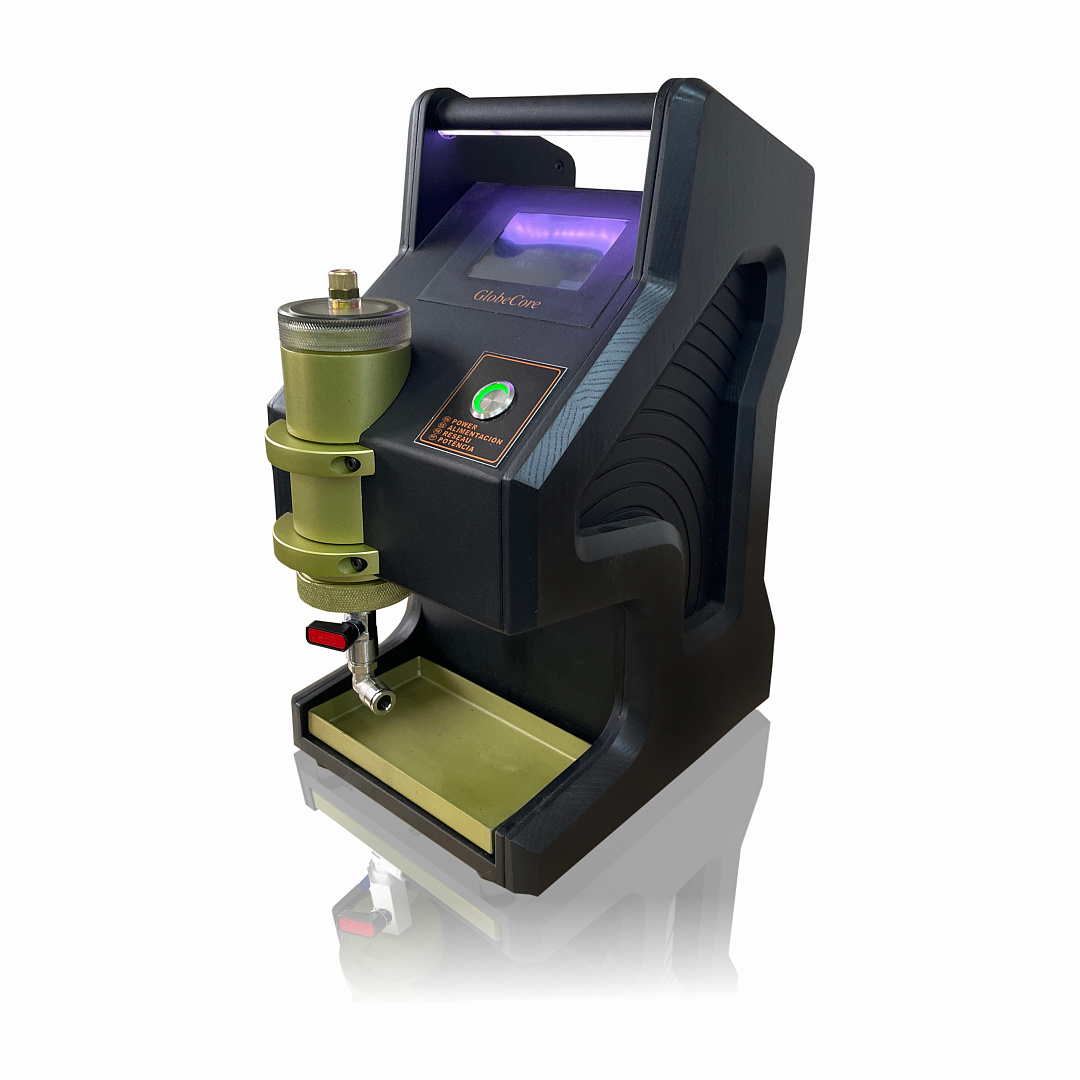
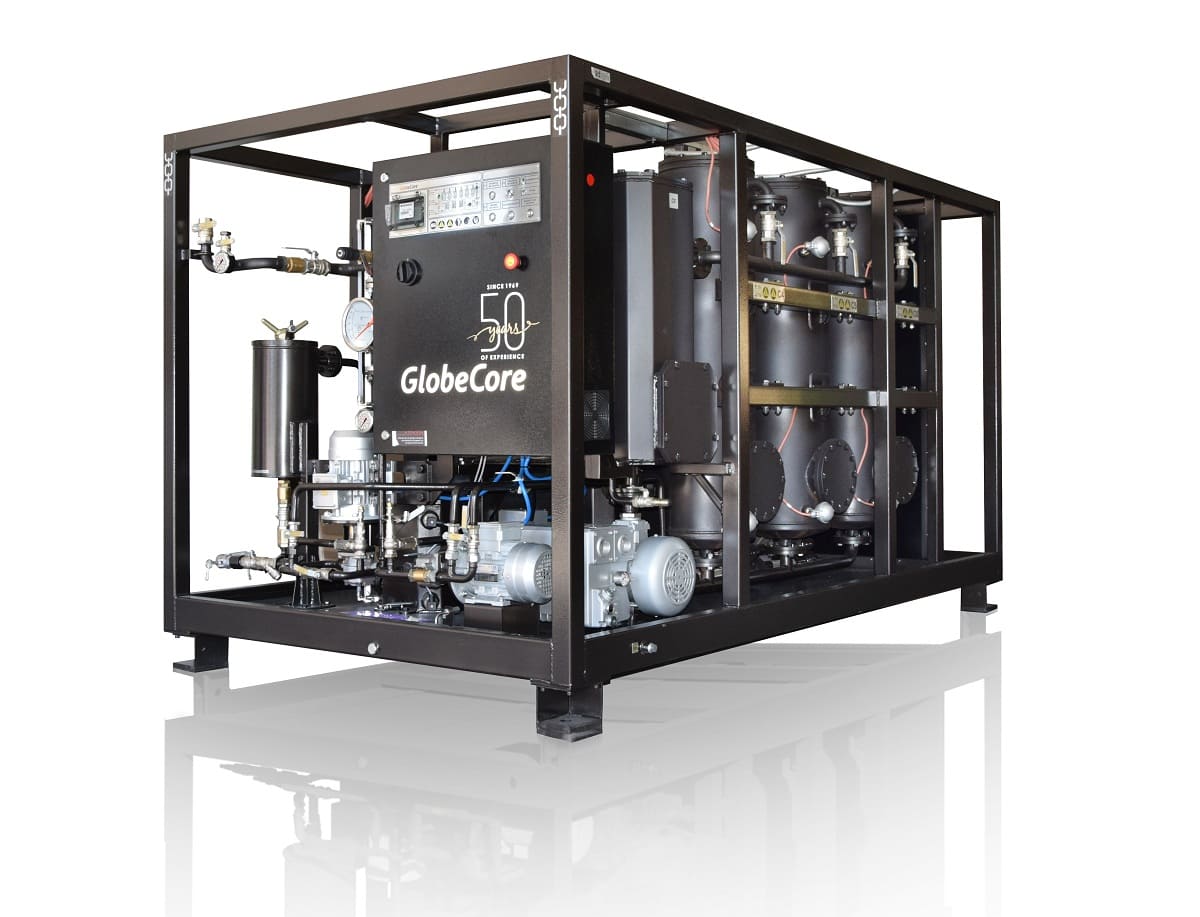
GlobeCore UVR units are designed for the regeneration and purification of fuels and used mineral oils. The UVR Process is a unique and Proprietary GlobeCore technology without equal anywhere in the world.