Industrial oils regeneration
Long use of industrial and motor oil causes accumulation of oxidation products and other contaminants. Together these substances adversely affect oil performance, drastically reducing the oil’s quality. To avoid failures of costly equipment, old used oils should be changed with new. Old oil is collected for special regeneration processing. Such operations saves oil for further use without the need to dispose of it. The environmental benefits of oil regeneration are obvious.
The first method that comes to mind in regard to oil regeneration is the recycling of waste industrial oil with crude oil in refineries. However, this is hardly possible due to additives, which improve oil’s performance. These additives may have a detrimental impact on the refinery’s equipment.Various regeneration processes may yield two or three basic oil fractions. By injecting additives into these fractions and blending them, one can produce sellable oils, coolants and lubricants or plastic lube substances.Literature gives some data on average yield of regenerated industrial oil from waste oil. For instance, an oil containing 2% to 4% solid particles and water and up to 10% fuel may yield 70% to 85% reclaimed oil. More specific numbers depend on the chosen reclamation method.
Regeneration of industrial oil includes several operations, based on various physical, chemical, and combined processes.Regeneration aims to remove contamination and aging products from oil. The following sequence is recommended for regeneration:
- Mechanical methods to remove free water and solid particles;
- Thermal methods for evaporation and vacuum distillation;
- Physical and chemical (coagulation and adsorption).
If, after the above methods are applied, the quality of the oil is still unsatisfactory, the use of more complex chemical equipment is required. Apparently, complex process equipment involves higher costs, which are not always justified or reasonable.The physical method allows to remove microscopic water droplets and solid particles, as well as some coke inclusions. Evaporation allows to remove volatile components. Other physical methods include subjecting oil to various fields: electric, gravity and magnetic, as well as centrifugal force and vibration. These also include purification of waste industrial oil by various heat and mass exchange processes, which remove highly volatile fractions, hydrocarbon oxidation products and water.The simplest method of oil purification is settling. The point is that solid particles and water settle naturally by the force of gravity.Settling can only be used as a stand alone method is the degree of contamination is insignificant. Otherwise it is only a preliminary stage, a preparation for deeper processes of filtration or centrifuge purification.
The settling method is limited by the duration of settling of particles, and the fact that only the largest particles, 50 to 100 micron, can be removed. Filtration, mentioned above, means removal of solid particles and resin compounds from industrial oil by mesh or porous filter media. To increase quality of the output product, the number of filters is increased for finer filtration.
Centrifuge is a well known method, which requires special equipment: the centrifuge. It facilitates removal of water and solid particles from the oil. The method involves separation of various fractions of oil under the influence of the centrifugal force.
Combined physical and chemical oil regeneration methods hold a place of their own; they include coagulation, selective solution and adsorption. Ion-exchange method is a variation of adsorption process.
Coagulation is a process of increasing the size of contaminant particles, which can be present in the oil in finely dispersed or colloid state. Practically this is done by introducing special coagulants into the oil, such as surfactants, which have no electrolytic properties, carious organic or non-organic electrolytes, as well as high molecular hydrophilic compounds and colloid solutions of surfactants.The duration of coagulation in used oil is 20 to 30 minutes on average. It depends on type and quantity of the coagulant, duration of contact with liquid, process temperature, efficiency of agitation etc.
After the process is complete, the enlarged particles can be removed from the oil, using settling, filtration or centrifuge separation. Adsorption also involves the use of special adsorbent substances. They can trap contaminants on the surface of the granules or inside the capillaries inside the granules. Adsorbents may come from various sources: natural (bauxites, natural zeolite, bleaching clay) or artificial (aluminum oxide, synthetic zeolite, alumina silicates and silica gels).There are several types of adsorption purification.
Contact method involves mixing of oil with small particles of adsorbent. The draw back is the need to dispose of a large amount of the latter, posing an environmental hazard.Percolation, when the product flows through the sorbent, also has drawbacks. One of the problems is that the sorbent, most often, silica gel, is a quite expensive material.Countercurrent method involves movement of sorbent and oil in opposing directions.
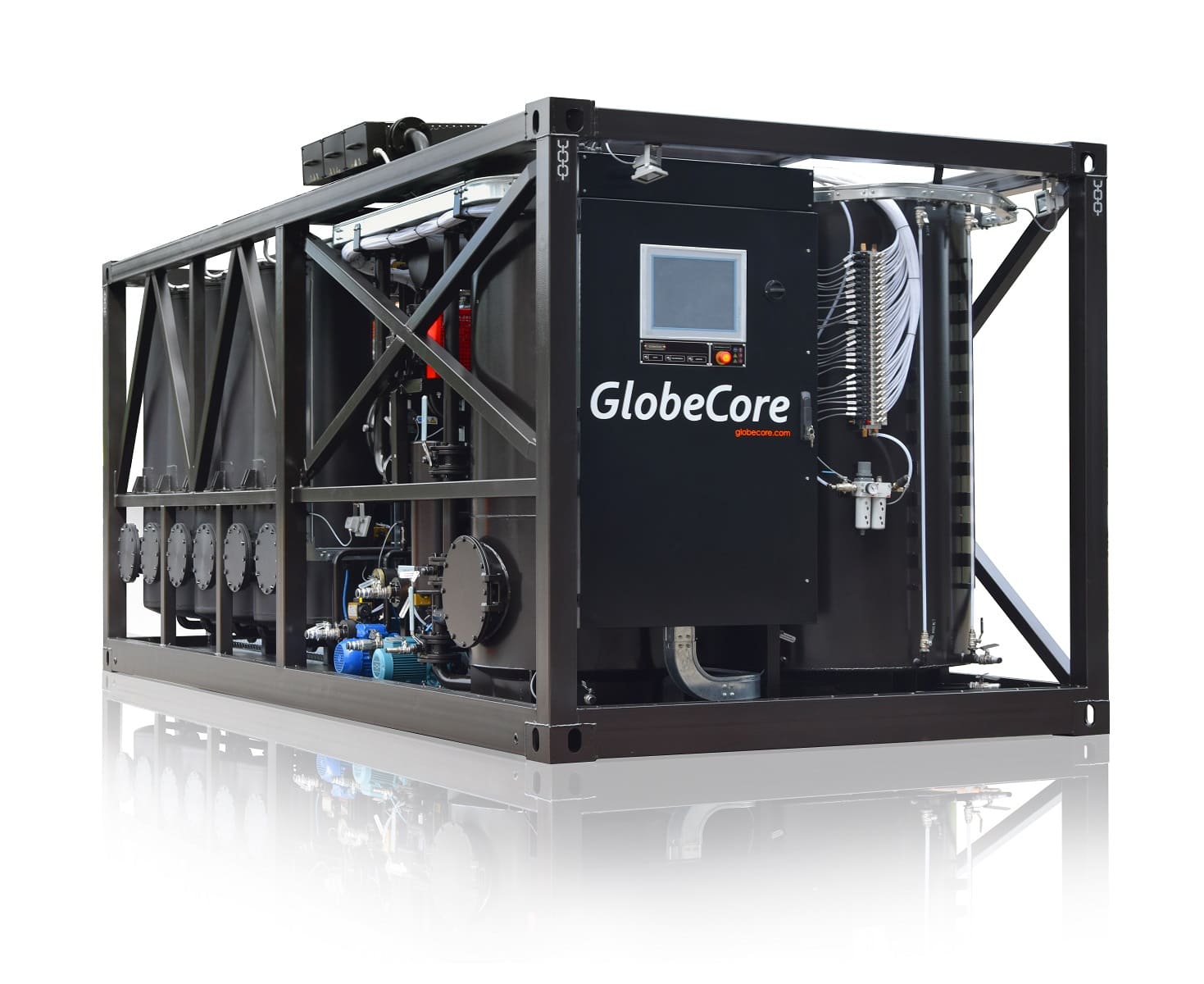
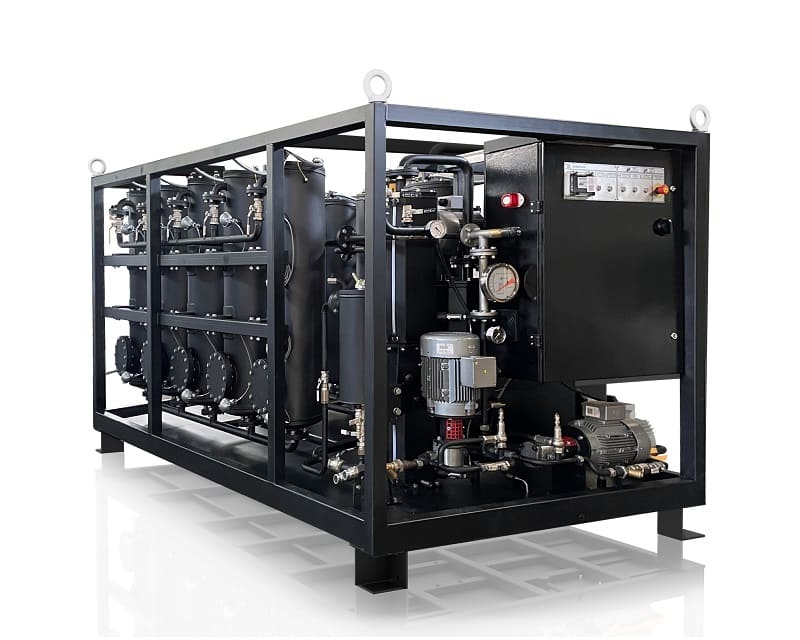
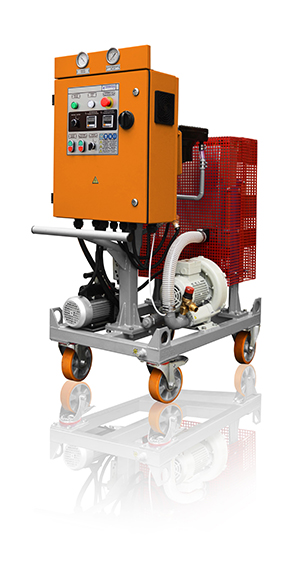
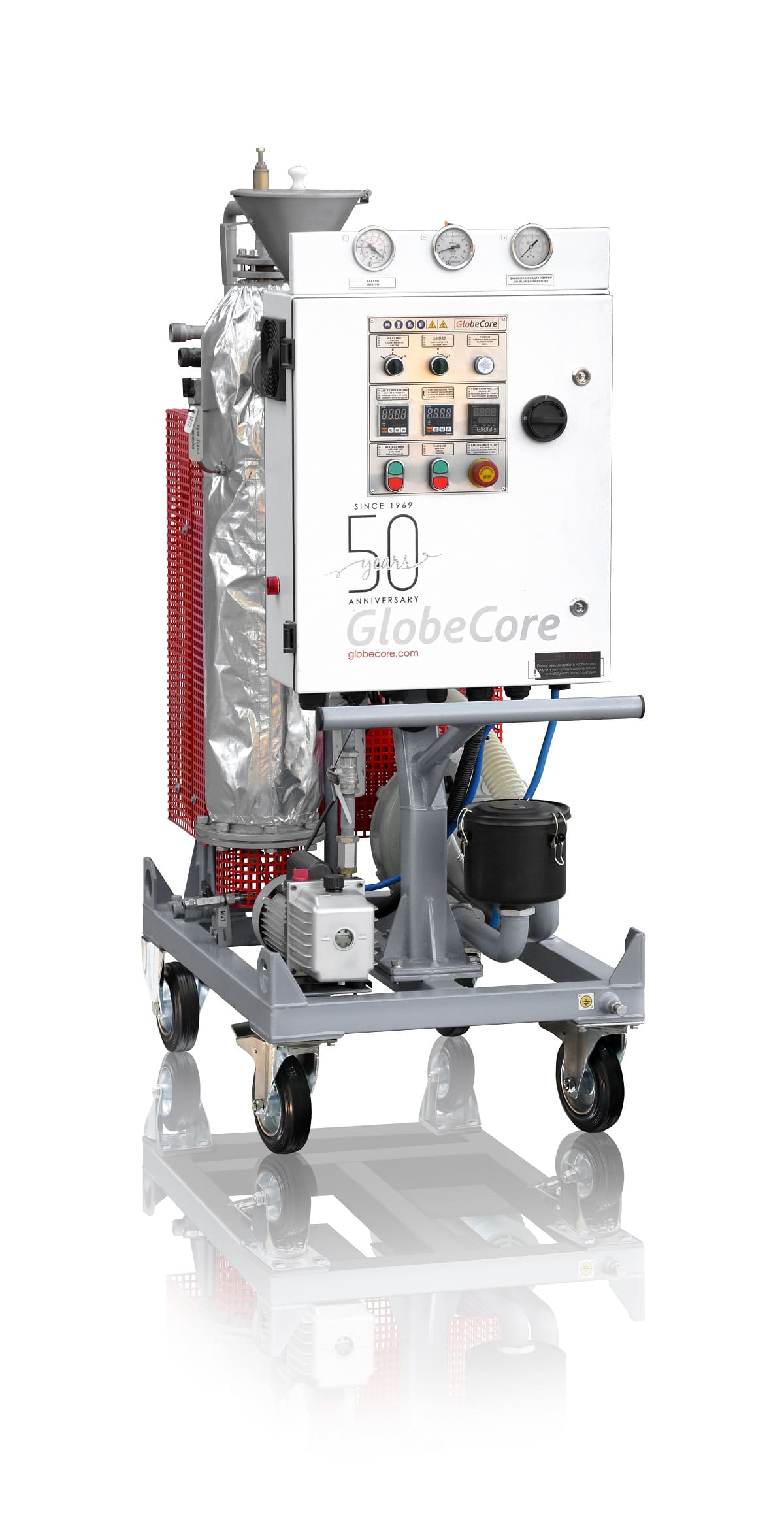
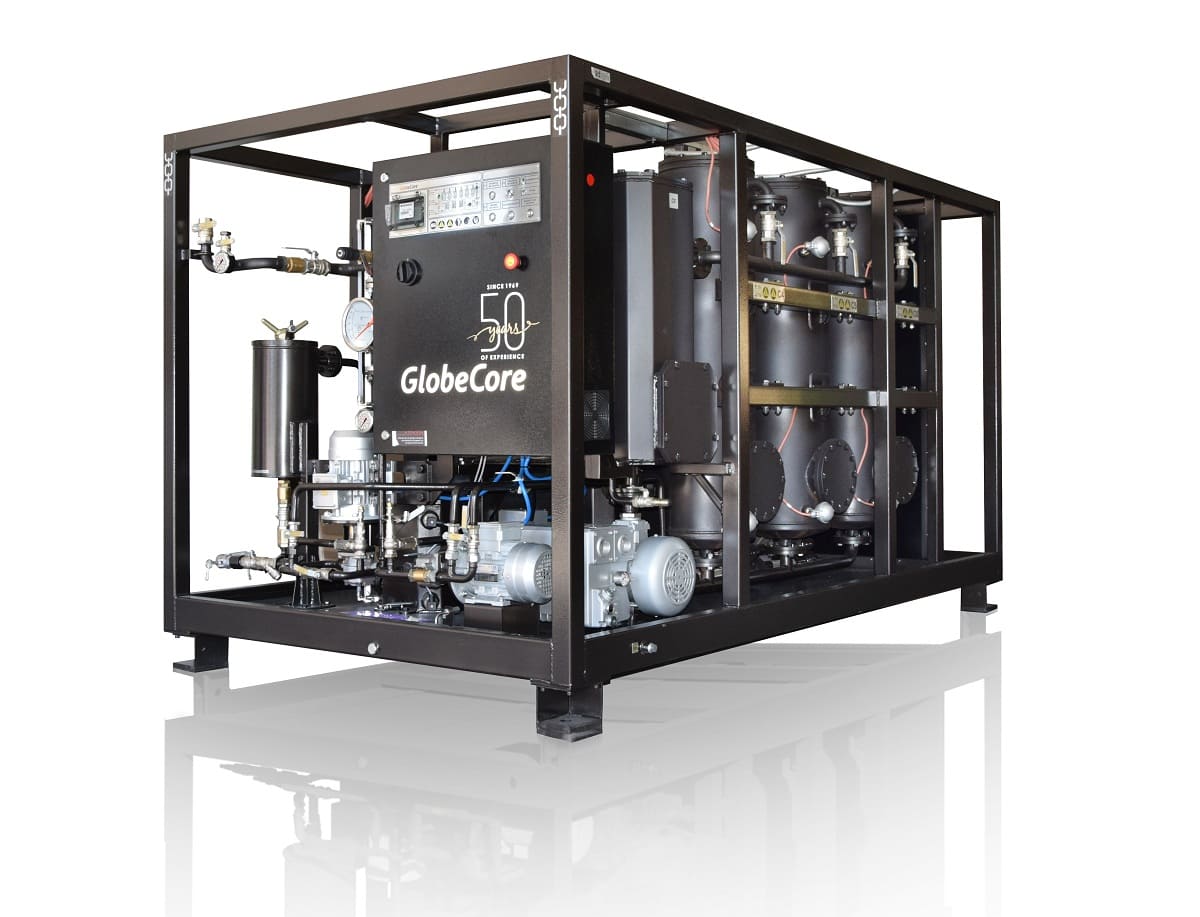
GlobeCore offers equipment which utilizes special adsorbent filters. These filters can be reactivated. The CMM-4F plants, for instance, purifies industrial oils from free and solved water, solid particles, water soluble acids and alkali. The viscosity of the oil for processing must not exceed 70 cSt at 50 oC.The unit may be used for installation, repairs and operation of oil filled equipment.
Depending on the task, the CMM-4F may be equipped with filter element for solid particles only, or one which also allows for adsorption of free and solved water.Ion exchange purification occurs due to the ability of ion exchange resins to capture foreign materials. Ion exchange resins look like solid hygroscopic gels. They are produced by polymerization and polycondensation of water-insoluble organic compounds and hydrocarbons.Waste industrial oil is mixed with 0.3 – 2 mm ionite granules.
Percolation is another option, where oil passes through columns filled with ion exchange resin. Contaminant ions replace the ions in the resin. The resin must be flushed with solvent, dried or activated by sodium hydroxide solution after the process. Unfortunately, ion exchange resins cannot remove tar from the oil, however, they remove acidic contaminants quite well.Selective purification is solution of separate contaminant in the oil: polycyclic hydrocarbons with short side chains, oxygen, sulfur and nitrogen compounds. Some of the possible solvents are nitrobenzol, phenol, furfurol, various spirits, acetone, methyl ketone and other like chemicals. A selective purification plant must be equipped with evaporators for distillation of the solvent.Treating of the oil with propane is another case of selective purification. The effect is that hydrocarbons dissolve in oil, while asphaltenes and tar precipitate and settle.
Chemical methods involve reaction between the reagents introduced into the oil and contaminants. The reactions result in compounds which can easily be removed form the oil. Some of the reagents are acids, alkali, oxides, carbides and metal hydrides.Hydrogen purification, sulfuric acid purification and sodium purification are some of the most widely used chemical methods.The use of sulfuric acid is prevalent. However, it results in formation of large amounts of acid tar, which is difficult to dispose of and poses a significant environmental hazard. Sulfuric acid also cannot remove polycyclic arenes with highly toxic chlorine compounds.From environmental viewpoint, the safest is hydrogen purification; the drawback being the large amounts of hydrogen consumed in the process.Metal sodium is used for removal of tar, oxidation products, highly toxic chlorine compounds and additives from the oil. The results of the chemical reactions are polymers and salts of sodium with high boiling temperature, which allows to distillate the oil.