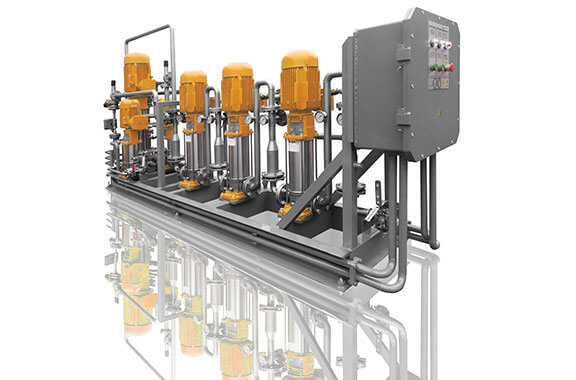
Turbine Gear Oil
The number of alternative energy generation sources is growing. The share of renewable power generation, according to some optimistic estimates, will reach at least 32% by 2030. This transition is spurred by the pressing environmental problems, such as harmful emissions, global warming etc.
Wind is an important source of renewable energy. In one form or another, wind energy was used in Babylon, Egypt and China. The Europeans began using the energy of wing in the 12th century. First applications were rather simple: grain mills, swamp drainage etc, but it was evident even then that wind is potentially a powerful source of energy. Denmark pioneered the use of wind for electricity generation. The first wind power plant was commissioned in 1890. In twenty years, almost a hundred wind power plants were operated in the world. In 2012, 806000 wind turbines were operated globally.
Wind power generation is made popular by its advantages: generation of electricity even at 4-5 meters per second wind speeds, environmental friendliness, renewability and operation either with the existing network of power plants or autonomously. The term of continuous operation of a modern wind turbine between maintenance is three years (30 000 hours).
This article deals with several issues related to extension of wind turbine service life:
- purpose of turbine gear oil;
- selection of turbine gear oil;
- change of turbine gear oil;
- CMM-G turbine gear oil change unit;
- the economic aspect of changing wind turbine gear oil.
Wind Turbine Design
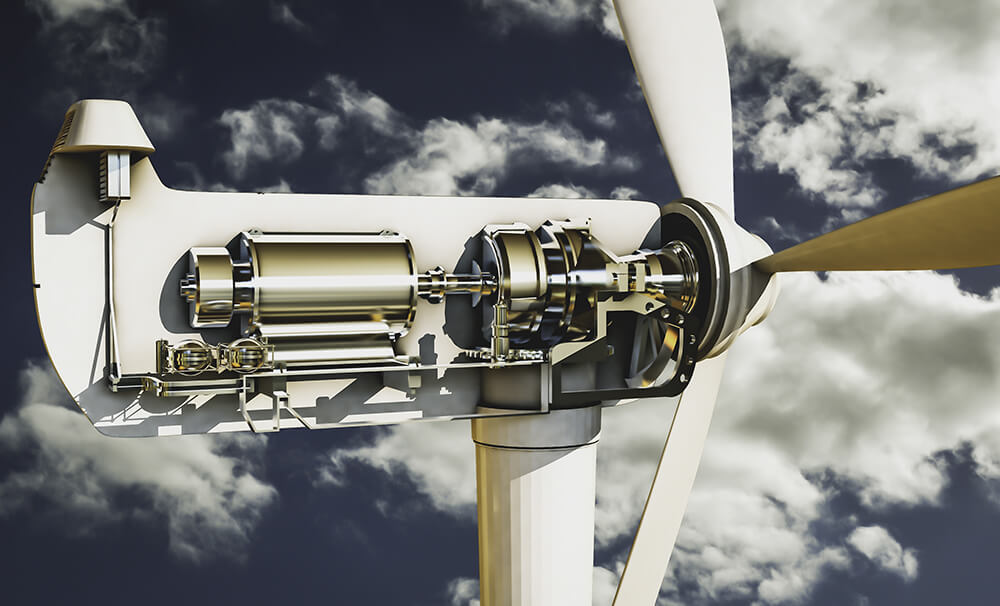
A wind turbine converts the power of wind into electricity. It is a complex device, which includes blades, a rotor, a gearbox, a generator, a brake, a controller, sensors and drives.
The blades capture the wind and are attached to the rotor, When wind speed reaches a certain threshold, the rotor transmits rotation to a slow-rotating shaft, connected to the gearbox. The rotation is then transmitted to the generator via a fast rotating shaft, and electricity is generated from that rotation. To generate power, the shaft must rotate relatively rapidly (1000-2000 rpm). It is impossible to achieve such speeds directly, as wind only causes 15-20 rpm rotation. The gearbox increases the rotation speed. Other parts of the wind turbines are these:
- the housing contains the shaft, the gearbox, the generator and the brake;
- the mast is attached to the foundation and the supports the housing. A ladder is installed inside the mast for service access;
- the brake stops the rotor if wind speed exceeds a certain threshold;
- the controller manages operation of the turbine;
- drives turn or align the turbine components;
- sensors detect necessary parameters (wind speed and direction) and supply information to the controller, which generates control commands.
New designs of wind turbines without blades or without the transmission come into existence, but most wind turbines are designed as described above.
The Gearbox – A Wind Turbine’s Most Vulnerable Part
The cost of the generator and the gearbox is 34% of the total cost of the turbine. The rotor accounts for 20% of the cost, while the supports cost 15%. The gearbox is expensive and, at the same time, the most vulnerable part of the wind turbine. Combined effects of adverse factors causes premature failure of this part. The most common causes of gearbox failure are overloads, high torque, seasonal temperature variations, variable wind speed, corrosion and frequent starts and stops. Considering the complexity of servicing, it is important to extend the lifecycle of the gearbox as much as possible. Wind turbine oil plays an important part in that.
The Purpose of Wind Turbine Oil
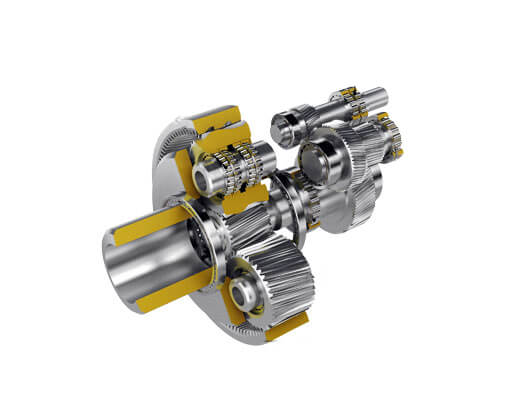
There are several “weak links” in wind turbines, which require timely lubrication. Those are blade bearings, main shaft, turn assembly, the generator and gearbox.
Wind turbine oil reduces friction and protects against corrosion and oxidation. It keeps the gearbox clean by additives which capture metal particles and prevent sedimentation on internal surfaces.
As mentioned above, new models of wind turbines without a gearbox are being developed. It is not exactly a new idea, since rotors of smaller turbines rotated fast enough for a direct connection to the generator. The current development is focused on eliminating gearboxes from large wind turbines. In some turbine models with small gearboxes, the wind turbine oil remains in the gearbox for its entire service life. There are no repairs, and the gearbox is replaced entirely with all it contains.
However, most units operated today are equipped with gearboxes and require turbine gear oil. Correct use of the lubrication material improves reliability and extends time between servicing of the wind power generators. Reliability of the turbine improves and the risk of unscheduled power outages is reduced.
Turbine Gear Oil Selection
Selection of turbine gear oil is as important as its correct use. The main requirements to the lubrication materials are:
- long life. The height of modern turbines reaches 100 meters, making oil change a challenging process. The less frequent the oil changes, the better;
- safe cold start. Most gearboxes operates at stable temperatures, but wind turbine gearboxes are the exception, since they are used in the open and are subject to weather factors;
- reliable high load operation, prevention of corrosion and premature wear of gearbox parts;
- resistance to water, no foaming and safety for service personnel.
- There are two primary types of oil in the market: mineral and synthetic. Each has its advantages:
- different mineral turbine gear oils can be mixed (it is not recommended to mix synthetic oils);
- mineral oils are better lubricants compared to synthetic oils;
- synthetic oil is more durable and performs better at various ambient temperatures.
The selection of a wind turbine gear oil is requires a case by case approach and consideration of all relevant factors.
Reasons for Wind Turbine Gear Oil Change
Wind turbine gear oil is used in adverse conditions: high loads, wind shears, varying temperature, high friction etc. The result is that oil performance and reliability of equipment falls over time.
Some of the factors which accelerate aging of wind turbine gear oil are:
- free and solved water;
- particles from the worn gears;
- gases;dirt.
Considering that the lubrication material comes in contact with all parts of the gearbox, it is reasonable to consider it a separate part of the entire unit, which requires monitoring and maintenance. One of the components of maintenance is total change of wind turbine gear oil.
The Main Problems of Wind Turbine Gear Box
Reduction of oil quality leads to certain problems in the gearbox of the wind turbine, such as micropitting and pitting, breaking of gear teeth and bearing. Micropitting is a surface fatigue which occurs on contact of gears.
The causes of this are:
- insufficient amount or uneven distribution of oil on the surface of the gears;
- incorrect selection of lubrication material;
- foam in the oil;
- regular changing of load.
Micropitting is the first stage of pitting, which results in breaking of gear teeth.
With the above in mind, it can be inferred that timely oil change is a good preventive measure to preserve the gears.
Wind turbine oil change
Ther are two approaches to initiating wind turbine oil change. One approach is to follow the guidance of oil manufacturer and to change the oil when warranty runs out, regardless of the actual condition of the oil. In this case oil is changed every two or three years. The second approach is to change the oil after detecting critical deviations of oil parameters by taking and analysing oil samples.
When the decision to change wind turbine oil is made, the change method is selected. In the past, several workers would form a line and pass buckets of oil from one to another to the gearbox and back to the ground. It may be difficult to believe, but this method is still used for wind turbine servicing sometimes.
A more advanced approach is to use mechanical devices to change wind turbine oil, reducing manual labor required to drain old oil and deliver new oil into the gearbox. Research shows that this is not sufficient. Up to 50% of the contamination remains in the gearbox after draining oil, along with some of the old oil. This causes quick aging of the new oil; besides, not all types of lubrication materials are compatible.
CMM-G Gear Oil Changer
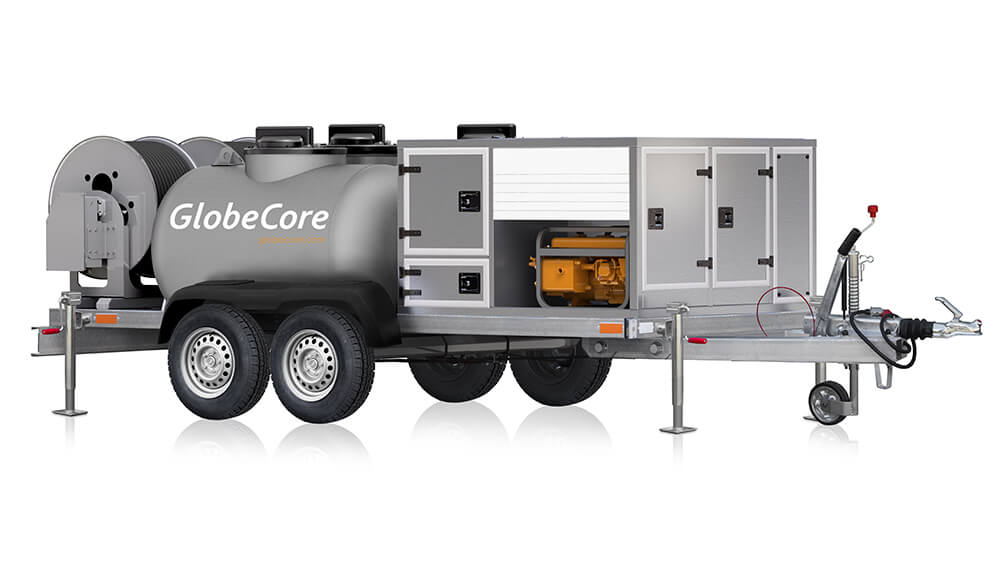
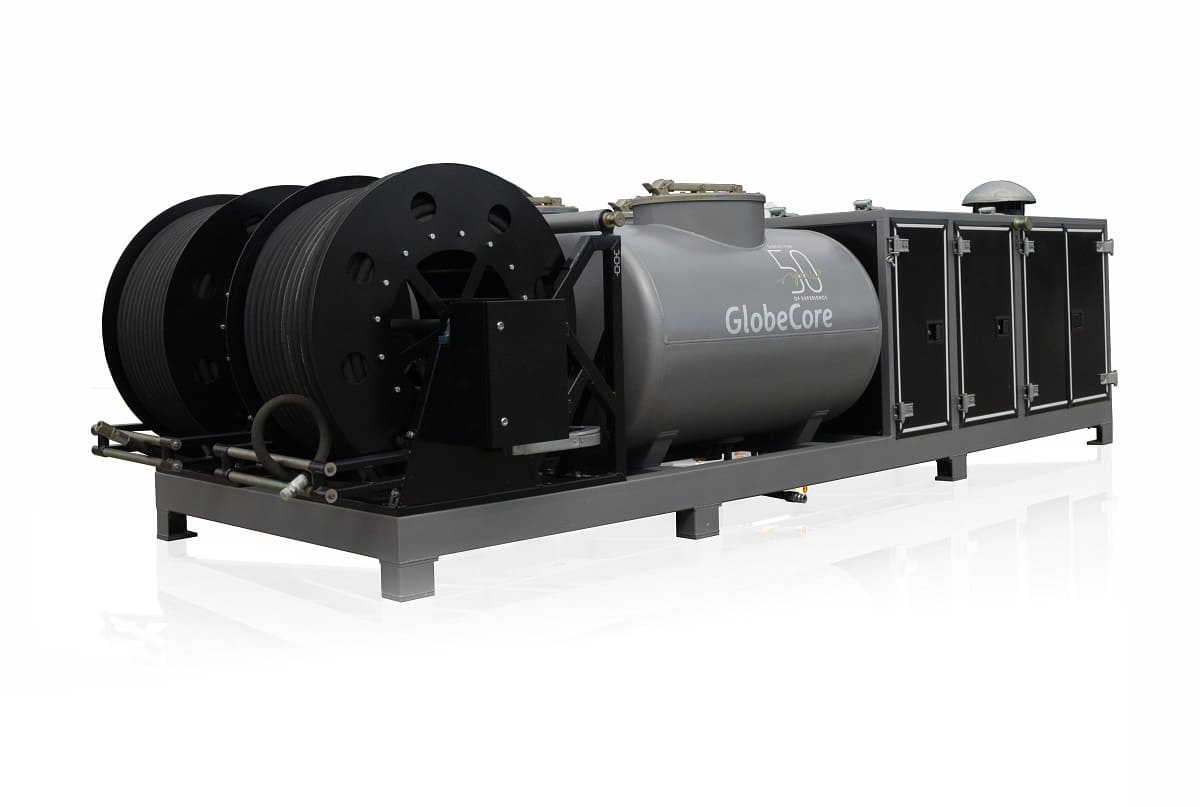
To address the wind turbine gear oil changing issue, GlobeCore has designed the CMM-G type unit. The main feature of this oil changer unit is that it includes one more stage. Beside draining and adding oil, the CMM-G unit also flushes the gearbox to remove all contaminants and remaining old lubricant. This allows to use the new oil to its fullest. The unit can also heat the oil before filling the gearbox. Both mineral and synthetic oils can be used. To switch from one oil type to the other, the unit must be flushed and its filter elements changed.
CMM-G Specifications
| No | Parameter | Value |
| 1 | Filling rate, m3/hour, not less than | 0.8 |
| 2 | Draining rate, m3/hour, not less than | 0.5 |
| 3 | Max output oil temperature in heating mode, ºС | 70 |
| 4 | Output pressure, MPa | 1.3 |
| 5 | Oil heater power, kW, max | 4.8 |
| 6 | Power consumption, kW, max | 8 |
| 7 | Power supply | |
| – voltage, V | 380 | |
| – Frequency, Hz | 50 | |
| 8 | Dimensions, mm, max | |
| – length | 5700 | |
| – width | 2400 | |
| – height | 1650 | |
| 9 | Empty weight, kg, max | 2500 |
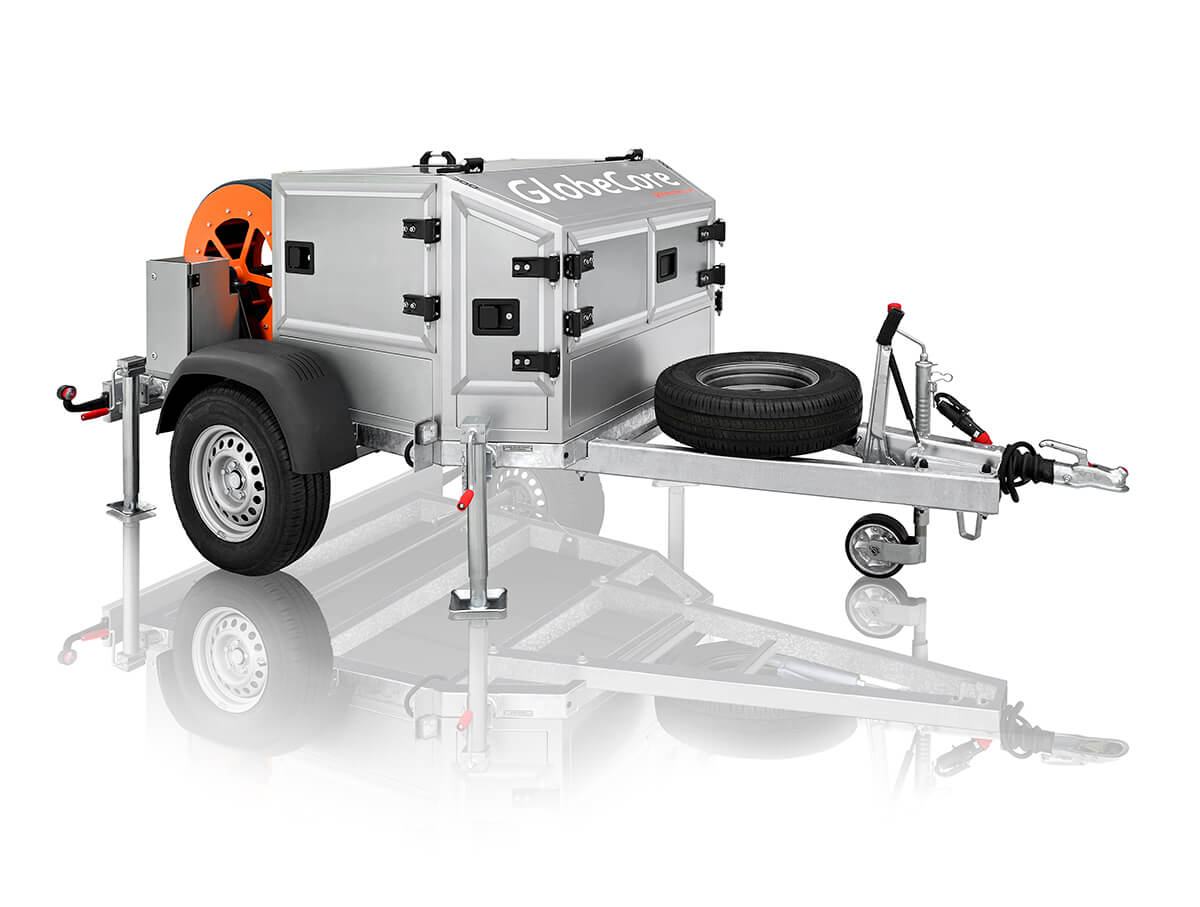
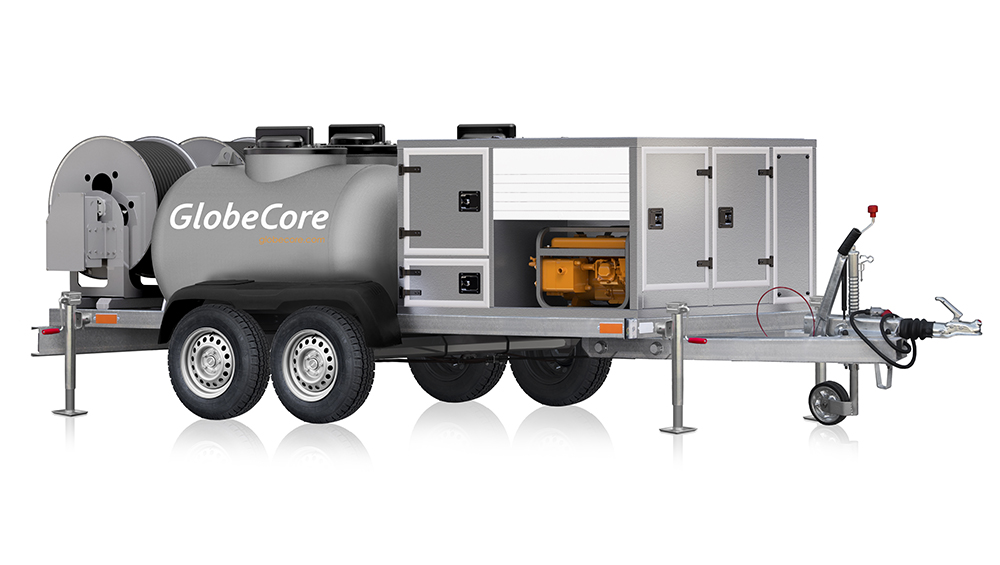
The CMM-G wind turbine gear oil changer consists of a housing, a clean oil tank, a used oil tank and drums for hoses. All parts are installed on a two axle trailer. Should power be unavailable, the unit can be powered by a generator. Valves are automated by a controller. The amount of oil supplied is recorded by a meter at the outlet of the filling hose.
A mesh filter protects pumps from large solid particles. A 12 micron fine filter removes particles which may have accumulated in the oil during storage and transportation. A sensor system ensures constant control of all CMM-G processes (oil temperature, filter contamination, outlet pressure, oil level etc).
The advantages of the GlobeCore CMM-G wind turbine gear oil changer:
- high quality servicing of wind turbine gearboxes;
- mobility and and transportation on trailer or in container;
- compact dimensions;
- sufficient volume of tanks to change oil in three wind turbine gearboxes;
- oil change takes no more than one or two hours;
- hoses can be rapidly reeled in on motorized drums.
Economic Viability
The economic viability of using the wind turbine gear oil changer compared to manual labor is obvious. For instance, changing 80 gallons of oil requires 12 hours for a team of two. The same volume can be changed within two hours by the CMM-G.
Alternative power generation companies have three options of oil change: purchasing the equipment, renting it or contracting the service.
Let us compare renting and purchasing a gear oil changer unit. Each of the solutions has advantages and limitations. Using the unit at only one wind farm with, for instance, 60 turbines, does not guarantee rapid return of investment. In this case it is better to rent the oil changer unit. However, owning the equipment is the correct choice and a profitable investment when operating several wind farms!
Some power companies prefer total control over the process of wind turbine oil change and gearbox flushing, starting from selecting the lubrication materials to training specialists for these operations. In other cases, the service is contracted to another company, which already employs qualified specialists, to change the oil and clean the gearbox.
The final decision regarding wind turbine gearbox maintenance methods is made depending on all factors that can be taken into consideration and analyzed.