

GlobeCore FAQ
Does GlobeCore offer a calcium carbonate grinding machine capable of achieving a particle size distribution of D90 = 200-300 nm as shown in your video, and what configuration or technology is required to reach this fineness?
- This topic has 3 replies, 4 voices, and was last updated 3 months, 3 weeks ago by .
Answers
-
January 29, 2026 at 3:19 am by Li Wei
GlobeCore does offer calcium carbonate grinding and dispersion using its AVS / AVSp vortex layer technology, which is shown in their videos for fine and nano-scale processing. However, achieving a guaranteed D90 = 200-300 nm is not a standard specification and strongly depends on the process setup: wet operation, use of dispersants, multiple passes in recirculation mode, cooling, and PSD measurement method. For nano-range targets, GlobeCore typically recommends AVSp units for lab/pilot trials, followed by industrial AVS units once the recipe is proven.
-
May 26, 2026 at 6:23 am by Craig Price
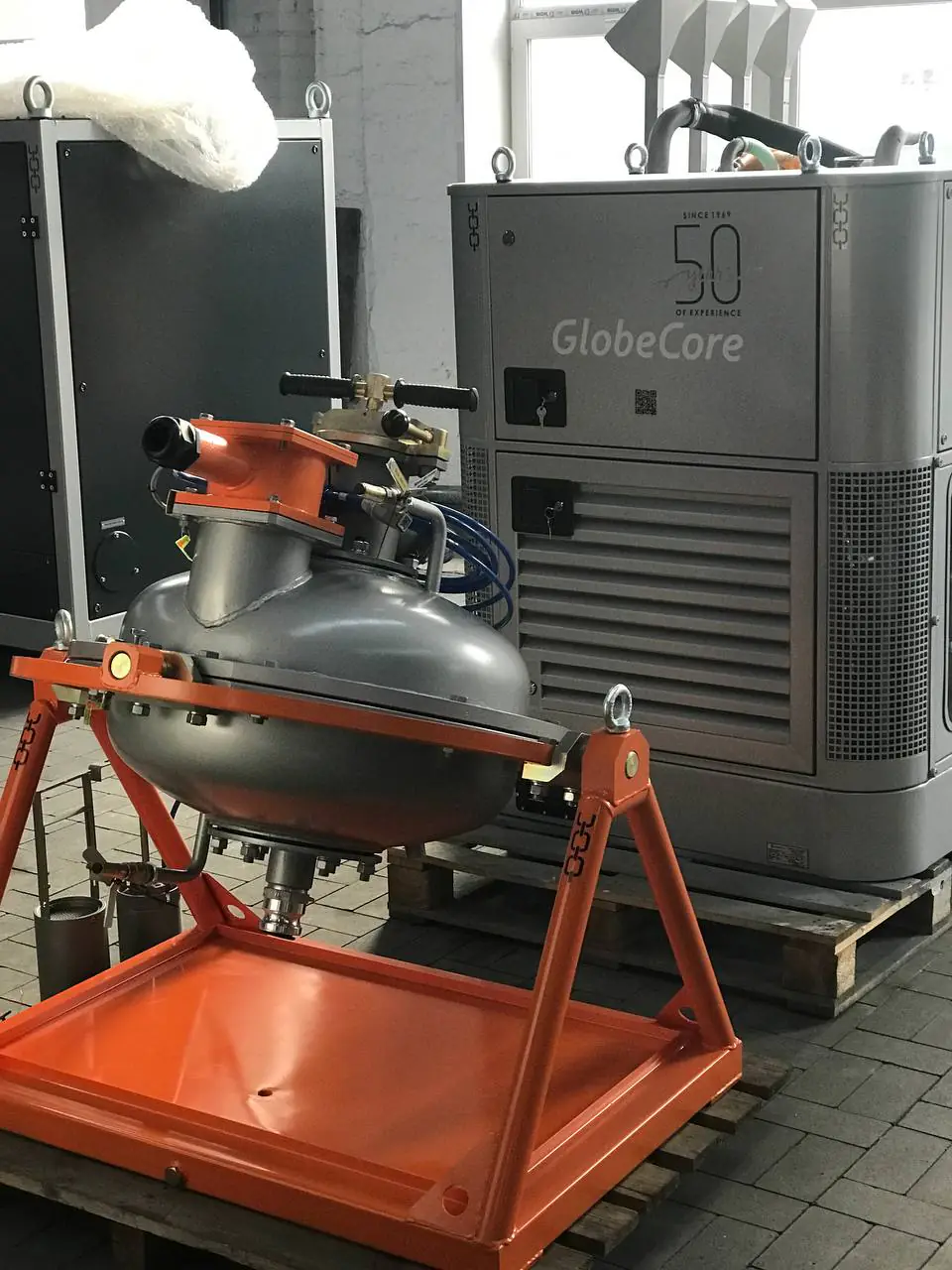
Another important factor for achieving submicron calcium carbonate particle sizes is maintaining stable energy transfer during the entire grinding cycle. In practice, even small fluctuations in slurry viscosity, temperature, or feed concentration can significantly affect the final particle size distribution (PSD) and lead to agglomeration instead of further size reduction. For that reason, many engineers prefer continuous-flow systems with intensive electromagnetic treatment and controlled recirculation. The AVS-150 machine shown below is a good example of how industrial-scale vortex layer processing can be arranged for high-energy dispersion and fine grinding applications.
Attachments:
-
May 26, 2026 at 6:30 am by Sonia Patel
You’re absolutely right — stable energy transfer across the entire grinding cycle is a decisive factor for submicron calcium carbonate and avoiding agglomeration. In practice that means running a continuous-flow, recirculating system with tight control of slurry viscosity, solids loading and temperature so the electromagnetic vortex layer in the AVS-150 operates in a consistent regime. Use of dispersants and pH control to wet and stabilize primary particles, effective degassing/anti-foaming, and staged recirculation (multiple passes or cascade stages) all help produce steady size reduction rather than re-agglomeration.
On the equipment side, the AVS-150 arrangement you show is well suited for high-energy vortex layer processing when combined with instrumentation and process control: reliable power regulation (VFDs), inline flow and temperature sensors, continuous viscosity monitoring, and preferably inline PSD sampling (laser diffraction) for feedback control. Start with lab/pilot trials on an AVSp to define solids concentration, dispersant type/dose, residence time and cooling strategy, then scale to the AVS-150 while preserving the same energy-per-unit-mass and control loops to hit a stable submicron D90.