

GlobeCore FAQ
Hello! Can this unit clean dyed diesel fuel used for agricultural machinery (it used to be dyed green and is now dyed with a blue reagent)? Will the cleaning process remove the dye, or only contaminants like water and particles?
- This topic has 5 replies, 5 voices, and was last updated 3 months, 3 weeks ago by .
Answers
-
January 29, 2026 at 2:46 am by Brandon Martin
A standard diesel purification unit can easily clean dyed diesel fuel by removing water and solid contaminants, but it will not remove the dye itself. The dye is a fully dissolved chemical component of the fuel and cannot be separated by filtration or vacuum treatment. To actually remove the color, special adsorption or chemical processes would be required, which are outside the scope of normal fuel cleaning equipment.
-
April 21, 2026 at 6:42 am by Craig Price
Another practical point worth considering is that dyed diesel behaves differently as compared to contaminated fuel, because the dye is molecularly dissolved in the hydrocarbon phase, rather than present as a separate impurity. This means that standard purification technologies—filtration, coalescence, or vacuum dehydration—are intended to remove heterogeneous contaminants (water, particles, sludge), but not the substances that are chemically integrated into the fuel.
In industrial practice, this distinction is important when setting up expectations: fuel polishing systems will restore cleanliness and operational reliability, but they will not change the chemical composition or appearance of the fuel. If decoloration is required, the process effectively switches from “cleaning” to selective separation of dissolved compounds, which typically involves adsorption media such as activated carbon or specialized resins, sometimes combined with multipass treatment.
It’s also worth noting that such dye-removal methods can unintentionally strip out beneficial fuel additives or alter fuel properties and are therefore typically applied only in controlled industrial scenarios rather than for routine maintenance.
If you want a clearer understanding of what standard fuel treatment systems are actually designed to remove and how dehydration and purification stages are typically arranged, you may find this overview helpful: https://globecore.com/fuel-processing/dehydration-of-fuel/. -
April 21, 2026 at 6:49 am by Gabriel Silva
You’re exactly right — dyed diesel is fundamentally different from contaminated fuel because the dye is molecularly dissolved in the hydrocarbon phase, not a separate particulate or free-water phase. Standard purification technologies such as filtration, coalescence and vacuum dehydration are designed to remove heterogeneous contaminants (water, sediments, sludge) and will restore cleanliness and operational reliability, but they will not remove dissolved dyes or otherwise change the chemical composition of the fuel.
Removing color requires switching from routine fuel polishing to selective separation techniques — typically adsorption on activated carbon or specialized resins, often in a multipass adsorption bed or polishing train. Those processes can reduce or remove dyes and other dissolved organics, but they also risk stripping performance additives or altering fuel properties (cetane, lubricity, stability) so they should only be used in controlled industrial settings with lab trials and post-treatment fuel testing. If you’d like, I can map these options to specific GlobeCore equipment (for example, how a polishing setup like the CMM-6RL differs from a basic purifier) and outline practical steps for a pilot treatment and quality checks.
-
May 26, 2026 at 6:34 am by Craig Price
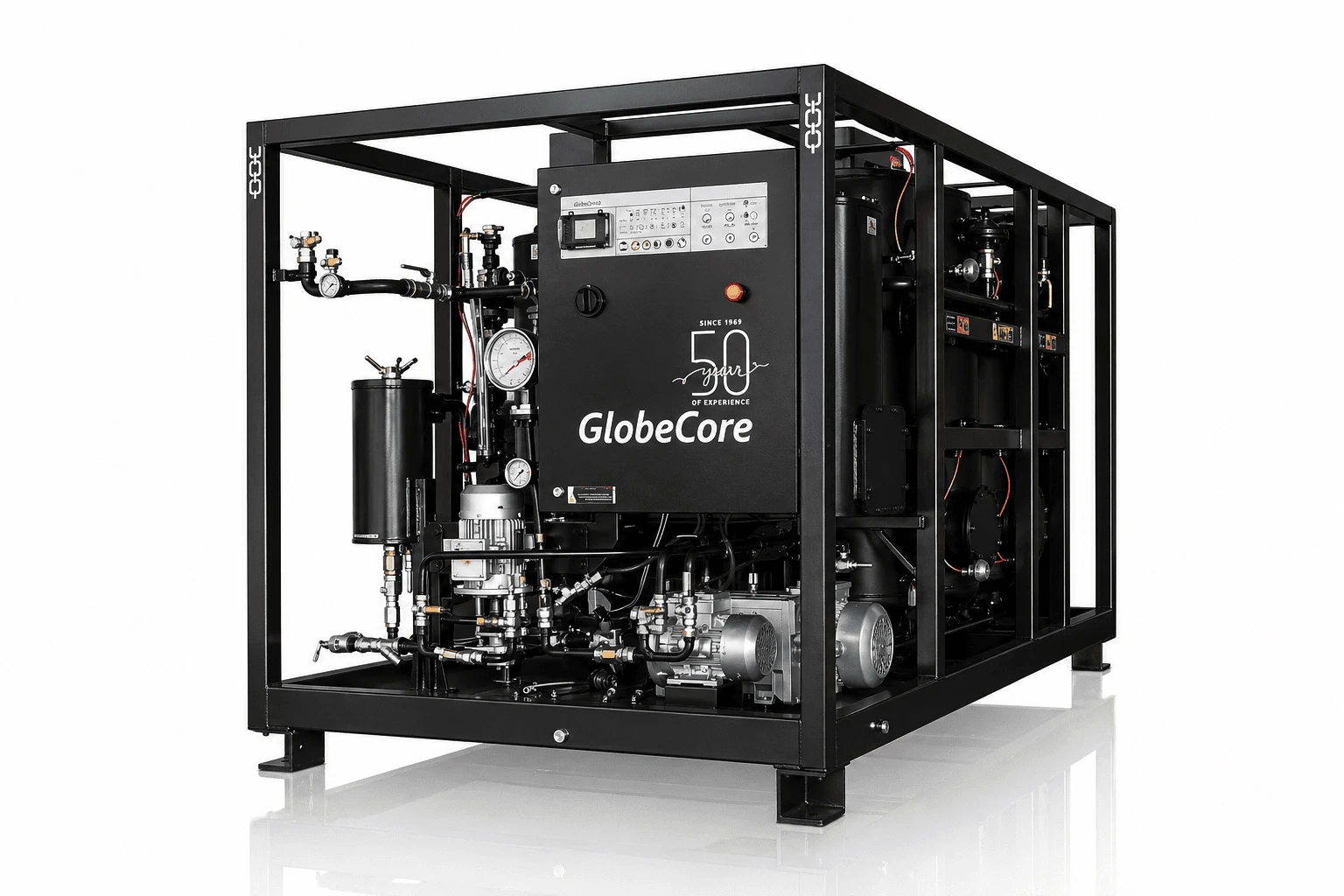
In many real agricultural applications, the main issue with stored dyed diesel is not just about the color, but the contamination caused by long-term storage in tanks exposed to moisture, dust, and temperature fluctuations. Even when the fuel visually looks acceptable, suspended particles and emulsified water can adversely affect injector performance and increase wear in modern diesel systems. For this reason, compact regeneration and filtration systems are often used directly on site before machinery refueling. The CMM-6RL plant shown below is one example of equipment designed for this type of fuel conditioning and contaminant removal.
Attachments:
-
May 26, 2026 at 6:37 am by David Lee
You’re correct — long-term tank storage exposes dyed diesel to moisture ingress, dust, microbial growth and thermal cycling, and those heterogeneous contaminants (emulsified water, free water, sludge and suspended particulates) are the real threats to modern injectors and high‑pressure fuel systems. Compact on‑site regeneration and filtration systems are precisely what’s used in agricultural practice to condition fuel before refueling: coalescing stages and fine filtration remove free and emulsified water and particulate matter, while adsorptive polishing trains address dissolved degradation products and organics that cause varnish and injector deposits. The CMM-6RL is an example of a polishing/regeneration unit that combines multi‑column adsorption for darker or contaminated fuels with the ability to reactivate sorbent media, whereas a standard purifier (like a CMM-1CF type unit) focuses on two‑stage filtration and coalescence to strip water and solids.
For practical operation, sample your tanks and measure water content, particle count and any microbial contamination, then condition fuel through your coalescer/filtration stage before final polishing; perform periodic sorbent reactivation and fuel quality checks afterward because adsorption can also remove some additives and change fuel properties. If you want, I can recommend a simple testing and treatment workflow for your tank volumes and typical contamination levels, and indicate how often to run polishing passes and service the sorbent beds to keep injectors protected and fuel performance reliable.