

GlobeCore FAQ
I want to process peat moss to extract humic and fulvic acids, with the liquid extract as the main product. Target throughput is ~1,000 L/hour. What equipment and extraction technologies would you recommend (mixing, extraction, separation/filtration, and concentration), and what setup works best for continuous production?
- This topic has 5 replies, 5 voices, and was last updated 3 months, 2 weeks ago by .
Answers
-
January 28, 2026 at 5:50 pm by William Foster
For continuous extraction of humic and fulvic acids from peat moss at ~1,000 L/h, I’d recommend alkaline extraction with process intensification using the GlobeCore AVS vortex layer device. AVS significantly accelerates mass transfer and improves yield by activating peat particles in the liquid phase. After AVS, use centrifugation and fine filtration, followed by membrane concentration to obtain a stable liquid extract suitable for fertilizers or additives.
-
May 1, 2026 at 9:32 am by Craig Price
Beyond the equipment already mentioned (AVS machines for intensification, centrifugation, filtration, and membrane concentration), it’s important to consider the overall process logic for continuous production, especially at ~1,000 L
In industrial practice, the extraction of humic and fulvic acids from peat is almost always based on alkaline extraction, since these compounds are soluble in basic media (typically KOH or NaOH solutions). The key challenge is not just to dissolve them, but to do so efficiently and consistently in a continuous flow.
From a process perspective, a robust continuous setup typically includes:
Raw material preparation (crushing and slurry formation) to increase surface area and ensure stable feeding into the system.
Intensified extraction stage (e.g., AVS or similar high-energy mixing technology), where mechanical activation significantly accelerates mass transfer and reduces extraction time compared to conventional batch processes.
Separation stage (centrifugation or decantation followed by filtration) to isolate the liquid phase containing humic and fulvic acids from solid residues.
Polishing and concentration that often involve the use of membrane systems or evaporation, depending on the desired final concentration and stability.
The key advantage of intensified technologies (such as vortex layer-based or ultrasonic-assisted extraction) is that they can reduce extraction time from hours to minutes while improving yield and reducing reagent consumption, which is essential for continuous operation at an industrial scale.
Another important point is process stability: in continuous systems, maintaining consistent pH, temperature, and solid-to-liquid ratio is critical for achieving uniform product quality. This is where modular configurations (reactor → separator → filtration → concentration) provide better control than simple batch systems.
If you want to see how such process intensification techniques are implemented in practice (including equipment configuration and operating principles), it’s worth reviewing this article: https://globecore.com/milling/humic-fertilizers-production-from-peat/. -
May 1, 2026 at 9:36 am by Stephanie Lee
Your summary is exactly the right process logic for a continuous, industrial-scale humic/fulvic extraction line; to make it practical for ~1,000 L/h I’ll add the key operating details and control points you’ll need to lock in during engineering and pilot runs. Start with raw-material preparation that delivers a stable, pumpable slurry: crush or mill peat to increase surface area (targeting a consistent particle distribution that feeds reliably through a metering pump), and prepare the slurry at a controlled solids concentration so the downstream AVS and separators see a repeatable load. Use robust positive-displacement feed pumps (progressive cavity or diaphragm) and mass/flow metering so you can maintain a constant solids-to-liquid ratio and accurate alkali dosing; automatic pH and conductivity control in the mixing tank is essential to hold extraction conditions steady in continuous operation.
Run the activated extraction in an AVS loop in either inline or recirculation mode, using the electromagnetic vortex layer to break agglomerates and accelerate mass transfer; tune energy input (kWh/m3), residence time (or number of passes), and loop cooling to avoid overheating and to hit target dissolution in minutes rather than hours. Immediately downstream, remove coarse and heavy minerals with screens and hydrocyclones, then perform more complete phase split with a decanter or clarifier centrifuge to protect membranes. Fine polishing ahead of concentration should include depth or cartridge filtration sized for the expected turbidity and solids load; membrane concentration is usually the preferred final step for a liquid product—start with ultrafiltration to retain high‑molecular‑weight humic fractions and then evaluate nanofiltration if you need higher concentration or partial salt removal. Design CIP/backflush capability, prefiltration stages and a robust anti‑fouling strategy because membrane flux and cleaning frequency will control operating cost.
Operational stability comes from instrumented control and modular redundancy: jacketed tanks and loop heat exchange for temperature control, inline pH/turbidity/viscosity monitoring, and PLC logic to balance AVS throughput, centrifuge feed, and membrane flux. Plan solids handling (dewatered peat cake drying/valorization), washwater recycling and alkali management (recovery or neutralization) to minimize reagent cost and effluent load. Finally, size the AVS unit(s) and separators conservatively or use parallel trains (AVS-100/AVS-150 combinations) so you can handle peaks and perform maintenance without stopping the whole line; run a pilot loop to define exact alkali strength, number of AVS passes, separator cut points and membrane selection before committing to full-scale installation.
-
June 4, 2026 at 6:31 am by Craig Price
For a 1,000 L/h line, it is also important to think about the process as a complete loop rather than just a single extraction step. Peat consistency, alkali dosing, treatment time, temperature control, and solid-liquid separation should all be balanced so as the extract remains stable and repeatable from batch to batch.
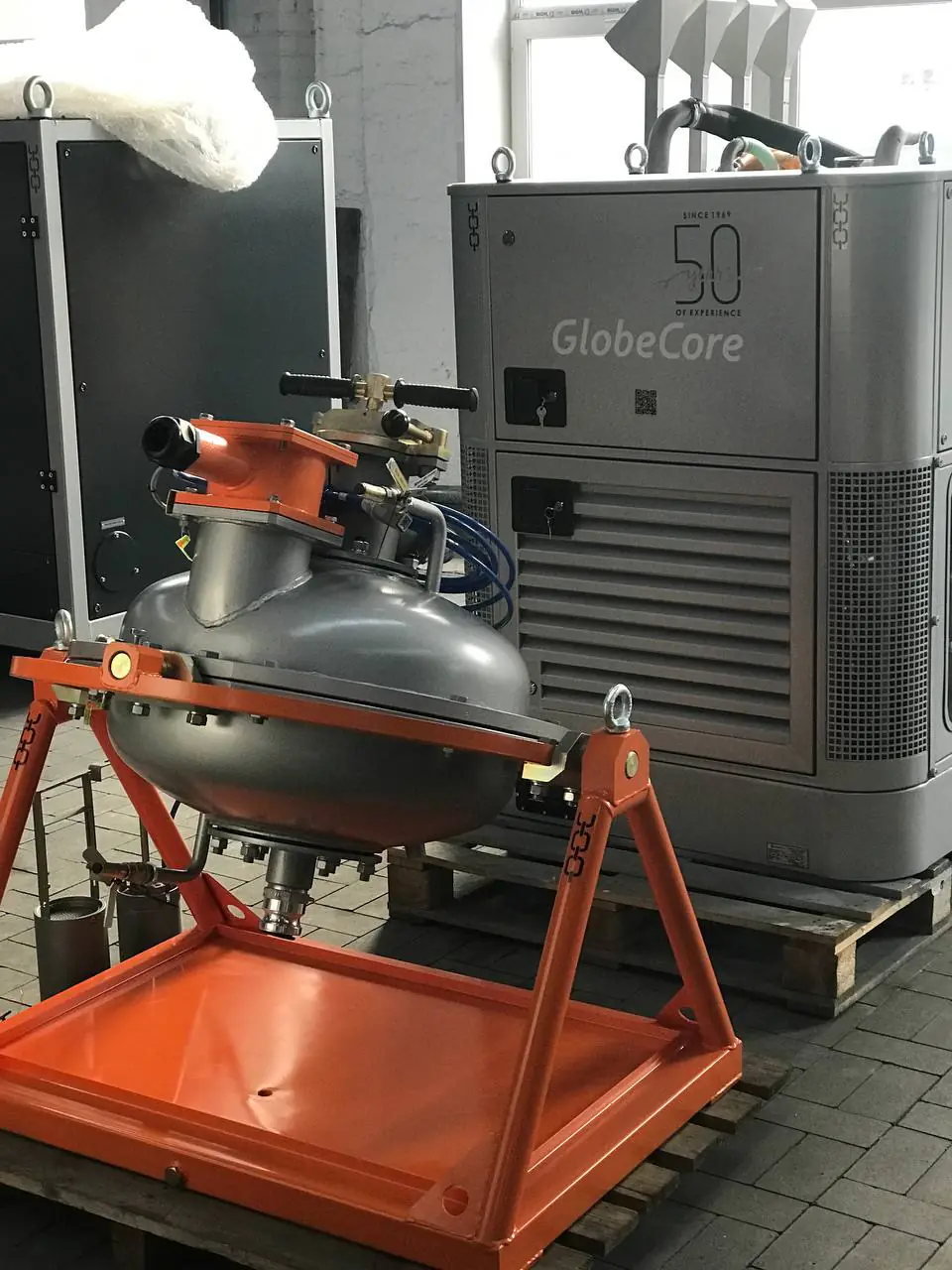
In continuous production, a recirculation stage can be very useful, because it allows the peat slurry to be treated more uniformly before separation. This helps reduce losses of active organic compounds and makes downstream filtration or concentration more predictable. The photo below shows an AVS-150 unit, which can be used as part of this type of intensified extraction and dispersion stage.Attachments:
-
June 4, 2026 at 6:40 am by Lucas Martins
You’re exactly right to think of the line as a closed, instrumented loop rather than a single unit. For a 1,000 L/h peat-slurry throughput I’d configure a feed/mixing skid with a controlled metering pump and automatic alkali dosing into a jacketed surge tank where solids concentration and pH are held to setpoints. Use robust positive-displacement pumps (progressive cavity or diaphragm) to feed the AVS vortex layer device in a recirculation loop so the slurry sees the AVS energy multiple times; this gives you tight control of effective residence time (minutes rather than hours), uniform particle activation and much more reproducible dissolution of humic/fulvic fractions. Monitor pH, conductivity, temperature and turbidity/TOC inline and tune the number of passes or loop flowrate until extraction endpoints are met; keep temperature controlled (moderate heating to accelerate extraction but avoid high temperatures that can degrade humics).
After the AVS loop, stage solids removal to protect downstream equipment: a coarse screen and hydrocyclone to remove grit and heavy minerals, then a decanter/clarifier centrifuge for bulk solids separation and a polishing depth or cartridge filter before membranes. Route clarified liquor to a membrane train (UF to remove colloids and retain high-MW humics, then NF/RO if you need higher concentration or partial desalting) with retentate recycle options to increase yield and reduce losses. Design for CIP and backflush on filters and membranes, and include a bleed product tank with pH and stability controls so you can produce a consistent liquid humic extract while recycling washwater and alkali where practical.
Operationally, build redundancy and modularity into the line so you can run parallel AVS/separator trains during maintenance or to handle feed variability; instrument control logic should balance AVS throughput, centrifuge feed and membrane flux to prevent bottlenecks. Plan solids handling (dewatered cake conveyance and possible valorization), alkali management (recovery or neutralization) and effluent recycling from the start. Validate the full loop with a pilot run to lock in alkali strength, solids concentration, AVS energy/number of passes, separator cut points and membrane selection before final scale-up to continuous 1,000 L/h operation.