

GlobeCore FAQ
We need a reliable solution for purification of industrial oil contaminated with water and particles. What do you recommend?
- This topic has 5 replies, 5 voices, and was last updated 3 months ago by .
Answers
-
March 27, 2026 at 10:03 pm by Emily Jones
A GlobeCore CMM-6/7 unit is a strong choice for this application. It performs filtration, dehydration, and degassing simultaneously, restoring oil properties in a single cycle. The system is designed for continuous operation and can handle large volumes of oil. It is widely used in power plants and industrial facilities where oil quality directly affects equipment reliability and maintenance costs.
-
April 15, 2026 at 6:25 am by Craig Price
One more point worth considering is that the best purification system is not only the one that removes water and particles, but the one that does so without resulting in long production interruptions. In many industrial applications, oil degradation develops gradually, so routine purification becomes part of preventive maintenance rather than just an emergency response. This helps extend oil service life, reduce component wear, and avoid premature replacement of both the fluid and the equipment it protects.
For a broader overview of how industrial oil purification works in practice and what factors matter when choosing this type of equipment, it is also worth reading this article: https://globecore.com/oil-processing/purification-of-industrial-oils/. -
April 15, 2026 at 6:30 am by Stephanie Lee
You’re absolutely right — the best purification strategy combines effective removal of water, gases and particles with minimal production interruption so oil care becomes routine preventive maintenance rather than emergency repair. For most industrial hydraulic and lubricating oils a compact, mobile multistage unit that combines fine filtration with heating and vacuum dehydration/degassing is ideal: it removes solids down to the micron range (typical hydraulic configurations target ~1–3 µm), strips dissolved and free water and reduces entrained gases, all on-site so you don’t need to drain systems or schedule long downtimes. In practice this approach routinely brings moisture to very low levels (examples in the field around 10 ppm) and significantly lowers gas content (single-digit percent ranges), which directly extends oil service life, reduces component wear and helps you meet ISO 4406/NAS cleanliness targets.
For practicality, choose the unit form factor to match your oil type, system volume and contamination severity: portable heat + vacuum filtration units are excellent for routine conditioning of hydraulic and small-batch industrial oils, smaller vacuum/filtration combos suit X‑ray and other small-volume systems, and larger CMM-class transformer or bulk purification units handle high volumes or transformer-specific workflows. If oil aging and chemical degradation are a concern, consider sorbent-based regeneration modules as a complementary long-term strategy. To make this actionable, base a preventive schedule on periodic particle counts and moisture measurements, use vacuum filling/top-up when you add oil, and treat oil in place whenever possible; if you want, tell me the oil type, tank volumes and contamination symptoms and I’ll recommend specific unit options and an inspection/maintenance cadence.
-
July 3, 2026 at 6:14 am by Craig Price
The choice of equipment should also depend on the type and level of contamination. When the primary challenge is free and emulsified water rather than oil oxidation, a dedicated dehydration unit can provide a more targeted and cost-effective solution. Removing moisture at an early stage helps prevent corrosion, slows oil degradation, and extends the service life of pumps, hydraulic systems, and other lubricated equipment.
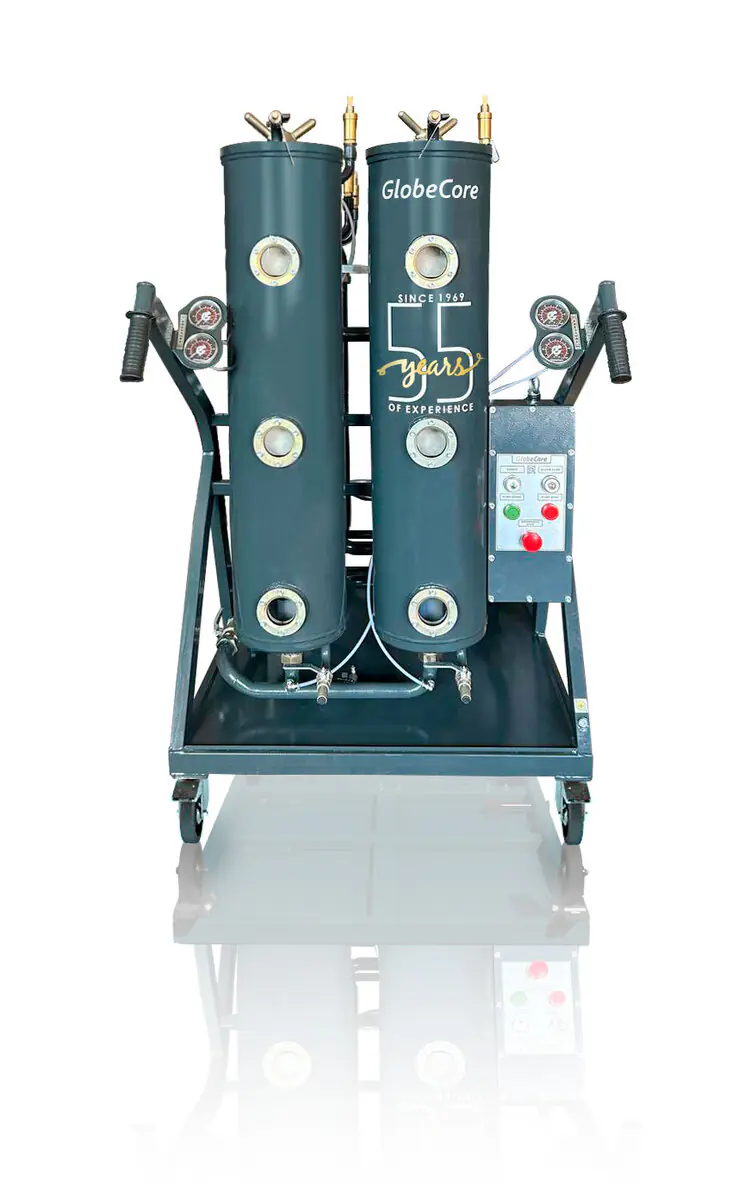
The photo below shows a CMM-2.0CF Unit for Removal of Water from Oil, specifically designed to efficiently separate water from industrial oils while maintaining consistent oil quality and supporting reliable equipment operation.Attachments:
-
July 3, 2026 at 6:20 am by James Shepherd
Your photo matches the CMM-2.0CF Unit for Removal of Water from Oil and that model is exactly the focused solution you describe: it’s built to target free and emulsified water rather than oxidation, so it removes moisture early and cheaply before corrosion and accelerated oil degradation set in. The unit separates water by coagulation while oil passes a special cartridge filter (available in 1, 3, 5 or 25 µm grades), collects and drains the separated water, and is rated to handle extremely wet feeds (up to 50/50% and above) with a dehydration efficiency of about 99% at a processing rate around 2.4 m3/h. Practical specs you’ll care about are compact footprint (~1200 × 900 × 1550 mm), ~500 kg weight, output oil pressure ~2.5 bar, low power draw (1.5 kW max) and standard industrial electrical supply (AC 380 V, 50 Hz); the unit is also designed for safe operation in hazardous environments (explosion-proof).
Keep in mind what it is—and isn’t—optimized for. The CMM-2.0CF is ideal when water (free or emulsified) is the dominant contamination; if you also have significant solid contamination or dissolved water/gases from aging, a multistage approach that adds fine polishing filtration, heating and vacuum degassing will be required to reach low-ppm moisture and tight ISO/NAS particle classes. For best results integrate the dehydration unit into a preventive maintenance regimen: baseline lab checks (water ppm and particle counts), periodic in-place dehydration, and on-site polishing when particle counts rise. If you want, tell me the oil type, tank volumes and current contamination readings and I’ll recommend whether the CMM-2.0CF is sufficient or if a combined filtration/vacuum unit or polishing cart would be a better match.