

GlobeCore FAQ
We want to process highly humified peat with high mineral content into a liquid extract for agricultural use, while retaining as much carbon/humic compounds as possible for maximum crop response. What extraction and separation technologies/equipment would you recommend?
- This topic has 5 replies, 5 voices, and was last updated 3 months, 3 weeks ago by .
Answers
-
January 29, 2026 at 2:12 am by Jason Taylor
For highly humified peat with high mineral content, the most effective solution is alkaline extraction (preferably with KOH) combined with process intensification using the GlobeCore AVS vortex layer device. AVS accelerates mass transfer and breaks agglomerates, allowing you to extract more humic carbon into the liquid phase without harsh temperatures or long processing times. After AVS, use early mineral removal (screen + hydrocyclone), followed by centrifugation and membrane concentration to retain maximum humic compounds in the final liquid extract.
-
April 21, 2026 at 6:22 am by Craig Price
One more important aspect to consider is that when working with highly humified peat containing a significant mineral fraction, the process sequence becomes critical for preserving humic carbon. In practice, it is often beneficial to separate the process into two controlled stages: first, intensive mechanical activation to release humic substances, and only then selective separation of mineral components. If mineral removal is performed too early or too intensively, part of the humic fraction—especially fine colloid particles—can be unintentionally lost together with the solid phase.
Technologies such as vortex layer activation are particularly useful here, because they not only reduce particle size, but also break lignin–cellulose structures and convert humic compounds into a water-soluble form, significantly increasing extraction efficiency without relying on harsh chemical conditions. This makes it easier to later apply “softer” separation methods (e.g., staged hydrocycloning or low-shear centrifugation) that minimize carbon losses while still reducing ash content.
Another point to consider is that, depending on the target product, it may be beneficial to evaluate the partial retention of ultrafine mineral fractions (e.g., clay-sized particles), as they can act as carriers for humic substances and enhance the stability of the final liquid formulation rather than being purely detrimental.
If you are interested in how this activation actually works at the process level (including particle size reduction to ~15 µm and conversion of organics into soluble form), I’d recommend taking a look at this detailed explanation: https://globecore.com/milling/peat-gel-production-in-vortex-layer-device/. -
April 21, 2026 at 6:29 am by Kevin White
You’re exactly right about sequence and gentleness: intensive mechanical activation up-front (vortex-layer activation with an AVS) to break agglomerates, reduce particle size to the sub‑20 µm range, and convert lignin–cellulose–bound organics into water‑soluble humic fractions makes the subsequent separation far less destructive to humic carbon. Running alkaline extraction (KOH) through an AVS in a recirculation or inline mode maximizes mass transfer and solubilisation so the humic fraction migrates to the liquid phase under mild chemistry and temperature, rather than being trapped in coarse solids that you’ll lose if you remove minerals too early or with high shear.
After activation, stage your solid/liquid separation to protect fine colloids: coarse screening followed by staged hydrocycloning tuned to split out the bulk mineral fraction while intentionally leaving ultrafine, humic‑laden particles in the liquor, then use low‑shear centrifugation (or gentle clarification) to polish solids without pulling colloidal humates out. Finish with membrane concentration (pilot test ultrafiltration/nanofiltration membranes and MWCOs to find the cutoff that retains the humic fraction while allowing excess electrolyte/ash to pass) so you concentrate humic carbon in the liquid extract. Targeted pilot runs to verify AVS residence time, target particle size (~15 µm), hydrocyclone split points and membrane selection are essential to balance ash reduction with maximum humic retention and stable final formulations.
-
May 26, 2026 at 6:44 am by Craig Price
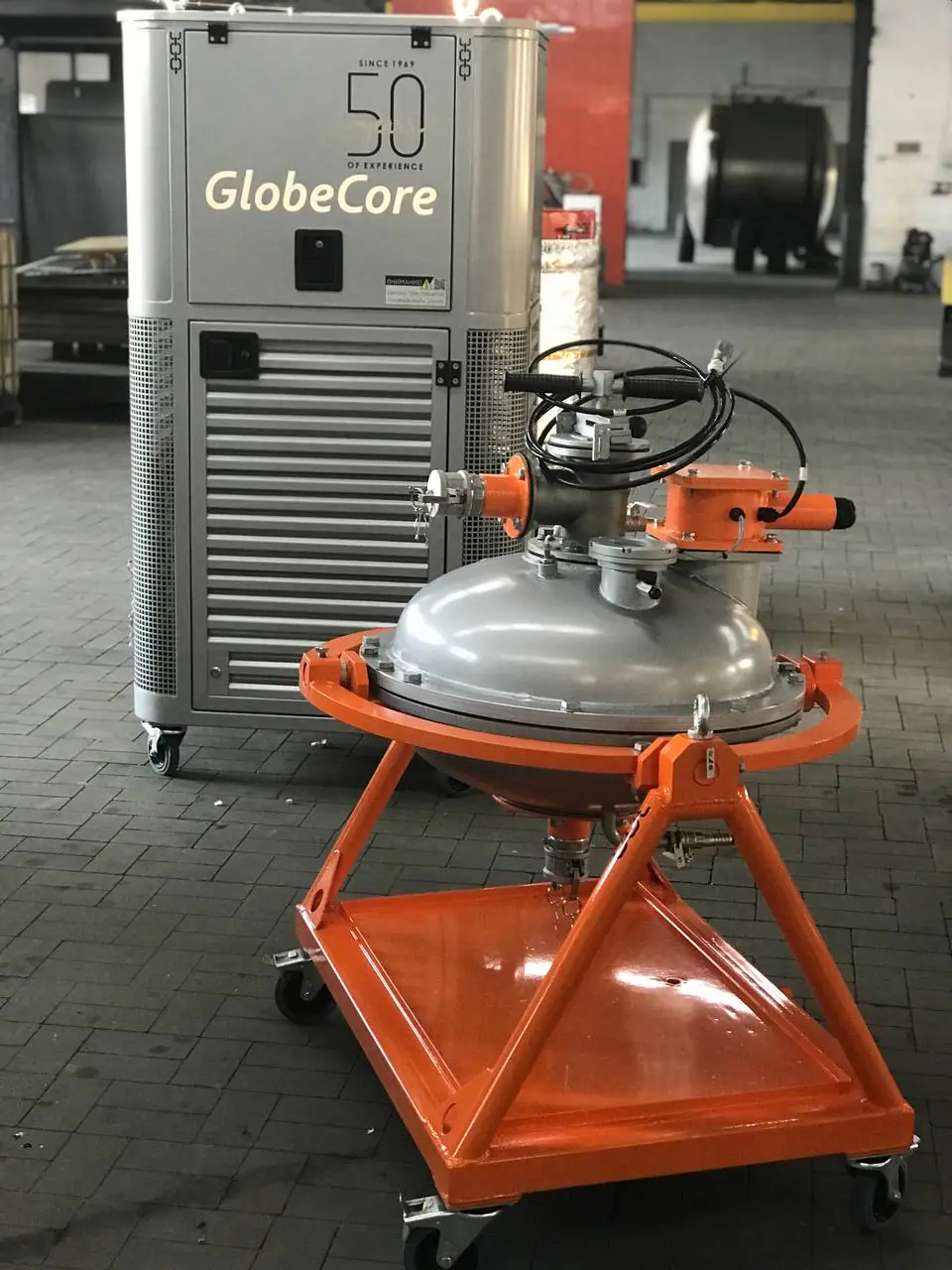
Another point worth considering is that highly mineralized peat should be treated not only as a source of humic substances, but also as a difficult slurry with abrasive and insoluble fractions. If these fractions are not controlled early, they can reduce extraction efficiency and cause problems during downstream clarification or concentration. In this case, intensive mixing and activation before separation can make the entire process more stable and predictable. The AVS-100 unit shown below is a good example of equipment that can be used at this stage to intensify extraction and prepare the peat slurry for further solid-liquid separation.
Attachments:
-
May 26, 2026 at 6:51 am by Maria Fernandez
You’re right to treat highly mineralized peat as an abrasive, difficult slurry rather than just a raw feedstock. The AVS‑100 is well suited as the upfront activation/mixing step: run an alkaline (KOH) extraction in a recirculation or inline AVS loop to break agglomerates, reduce particle size toward the ~15 µm target and solubilize humic fractions while keeping temperatures and chemistry mild. That front‑end intensification stabilizes extraction performance and moves the bulk of humic carbon into the liquid phase so downstream separation can be operated softly and selectively.
To protect equipment and maximise uptime, design the feed and separation train for abrasion control and solids management. Install coarse screening and a grit trap ahead of pumps and the AVS to remove large stones and debris, control feed solids concentration and viscosity (dilution/conditioning to an optimal % solids for AVS operation), and use staged hydrocycloning to split coarse mineral load from the humic‑rich fines. Specify wear‑resistant wet‑end materials (high‑chrome/ceramic hardfacing, tungsten‑carbide coatings or polyurethane liners for cyclones/screens) and pumps rated for slurries (hardened centrifugal or suitably protected progressive‑cavity/diaphragm types) with easy access replaceable wear parts. Finish with low‑shear clarification (gentle centrifuges or settling) and membrane concentration protected by prefiltration and regular CIP/backflush to avoid fouling from abrasion/ash. Planned spare‑part inventory and inspection intervals for wear components will make the process predictable and keep extraction efficiency high while minimising carbon losses.