

GlobeCore FAQ
What equipment and filtration technologies would you recommend for cutting soluble oil (coolant) filtration to remove fine particles and extend fluid life?
- This topic has 3 replies, 4 voices, and was last updated 4 months, 2 weeks ago by .
Answers
-
January 28, 2026 at 9:11 pm by Mohamed Alam
For cutting soluble oil (water-miscible coolant), the best “life-extension” setup is a side-stream filtration loop that combines a coarse prefilter (bag or wedge-wire screen), then fine depth filtration (cartridge or high-capacity bag, typically ~5-20 µm depending on nozzle/tooling sensitivity). If you’re fighting very fine grinding swarf, add a centrifugal separator or hydrocyclone ahead of the fine filters to reduce loading and keep ?P stable. To really extend coolant life, pair solids removal with tramp-oil removal (skimmer/coalescer) and-when needed-crossflow microfiltration/ultrafiltration to pull out sub-micron fines and emulsified contaminants without constantly dumping the sump.
-
May 4, 2026 at 5:59 am by Craig Price
One additional point to consider is how stable the filtration performance remains over long operating cycles, especially in systems where coolant contamination is continuous (e.g., grinding or high-speed machining). Even well-designed fine filtration stages can lose efficiency as filter media loads, so pre-conditioning the fluid before fine filtration becomes critical.
For example, integrating a vacuum-based separation stage can significantly improve overall system performance. While typically associated with oil purification, vacuum systems are also effective in removing dissolved gases, excess moisture, and volatile contaminants, which are often overlooked in coolant maintenance, but still affect fluid stability and tool service life. The principle is based on lowering pressure so as water and gases evaporate at lower temperatures and are extracted from the fluid flow.
Another practical benefit of combining vacuum treatment with filtration is that it reduces the load on fine filters, helping maintain a stable differential pressure and extending service intervals. This becomes essential in centralized or continuous filtration setups, where downtime and filter replacement costs quickly add up.
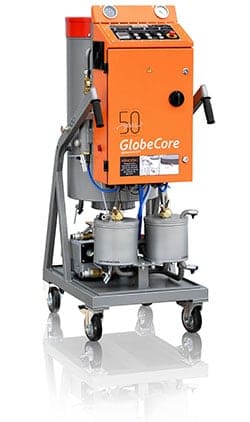
If you want a clearer explanation of how vacuum filtration and multi-stage purification systems are implemented in real industrial applications, this article is definitely worth reviewing: https://globecore.com/oil-processing/vacuum-oil-filter-machine/. -
May 4, 2026 at 6:04 am by Oliver Andersen
You’re right — pre-conditioning is critical for long-cycle stability. Degassing under vacuum (or dedicated vacuum degassers) can meaningfully reduce entrained air, dissolved gases and volatile organics that destabilize water‑miscible emulsions, promote foaming and accelerate microbial growth, so it lowers the burden on fine depth filters and helps keep ΔP stable over long runs. In practice you’ll see the biggest benefit when vacuum treatment is used in a sequence with mechanical separation: remove coarse swarf and tramp oil first (skimmer/coalescer or centrifugal/hydrocyclone), then degas, and finally send the fluid through the fine magnetic/cartridge stages. That ordering preserves filter life and reduces frequent filter changes in continuous or centralized side‑stream loops.
Take care with vacuum on water‑based coolants because aggressive dehydration or high temperatures can change coolant concentration and risk breaking the emulsion. Use degassing modules sized and controlled for coolant chemistry (modest vacuum levels, short residence time, condensers/vapour recovery and automatic sump concentration monitoring/makeup dosing). Trial the approach on a pilot loop to confirm you don’t strip needed volatiles or destabilize additives. Combined with magnetic capture for ferrous fines and centrifugal pre‑separation ahead of the CMM‑F style two‑stage filtration, this multi‑stage setup delivers stable long‑term performance, lower total filter costs and extended coolant life.