

GlobeCore FAQ
What equipment can be used for transformer oil degassing and dehydration on-site?
- This topic has 5 replies, 5 voices, and was last updated 5 months, 1 week ago by .
Answers
-
March 27, 2026 at 4:46 pm by Yara Haddad
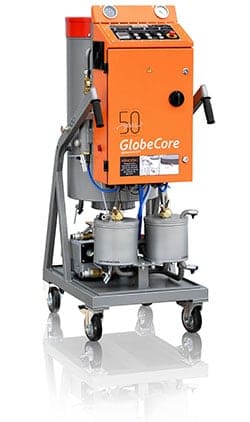
A CMM-4/7 vacuum oil purification unit is a practical solution. It combines filtration, heating, and vacuum degassing, allowing efficient on-site oil treatment.
-
April 29, 2026 at 7:31 am by Craig Price
In addition to compact units like the CMM-4/7, it is worth highlighting that the efficiency of on-site transformer oil degassing and dehydration largely depends on how the vacuum treatment process is engineered within the equipment.
In modern CMM-type units, the oil is not simply heated and pumped through a vacuum chamber; it is typically distributed as a thin film or dispersed flow, which significantly increases the surface area exposed to vacuum. This enables faster moisture evaporation and more efficient removal of dissolved gases compared to basic vacuum circulation systems.
Another important consideration for field applications is multi-mode operation. For example, the same unit can operate in the following modes:
Filtration mode (for quick purification);
Heating and Filtration mode (for moderate contamination);
full Degassing/Dehydration mode (for deep high-vacuum treatment).
This flexibility is critical for on-site use, where oil conditions can vary significantly and switching between operating modes may be required without changing the equipment.
Furthermore, many modern systems are designed to operate directly on energized or de-energized transformers, enabling maintenance without extended outages, which is a key advantage for power utilities.
Therefore, when selecting appropriate equipment, it is not only about having filtration, heating, and vacuum degassing functions within a single unit, but also about process efficiency, operational flexibility, and real-world adaptability, all of which directly affect treatment time and final oil quality.
For more detailed information on transformer oil degassing technologies and equipment configurations used in practice, refer to this article: https://globecore.com/oil-processing/transformer-oil-degassing/. -
April 29, 2026 at 7:31 am by Craig Price
In addition to compact units like the CMM-4/7, it is worth highlighting that the efficiency of on-site transformer oil degassing and dehydration largely depends on how the vacuum treatment process is engineered within the equipment.
In modern CMM-type units, the oil is not simply heated and pumped through a vacuum chamber; it is typically distributed as a thin film or dispersed flow, which significantly increases the surface area exposed to vacuum. This enables faster moisture evaporation and more efficient removal of dissolved gases compared to basic vacuum circulation systems.
Another important consideration for field applications is multi-mode operation. For example, the same unit can operate in the following modes:
Filtration mode (for quick purification);
Heating and Filtration mode (for moderate contamination);
full Degassing/Dehydration mode (for deep high-vacuum treatment).
This flexibility is critical for on-site use, where oil conditions can vary significantly and switching between operating modes may be required without changing the equipment.
Furthermore, many modern systems are designed to operate directly on energized or de-energized transformers, enabling maintenance without extended outages, which is a key advantage for power utilities.
Therefore, when selecting appropriate equipment, it is not only about having filtration, heating, and vacuum degassing functions within a single unit, but also about process efficiency, operational flexibility, and real-world adaptability, all of which directly affect treatment time and final oil quality.
For more detailed information on transformer oil degassing technologies and equipment configurations used in practice, refer to this article: https://globecore.com/oil-processing/transformer-oil-degassing/. -
April 29, 2026 at 7:39 am by Ashley Hall
You’re right to focus on how the vacuum stage is engineered: the fastest, deepest dehydration and degassing comes from designs that disperse oil into a thin film or fine droplets under a two-stage vacuum (fore‑vacuum plus booster), combined with effective heating and coarse/fine filtration. Portable CMM‑type units implement exactly that approach, offering multi‑mode operation (filtration only; heating + filtration; full degassing/dehydration) so a single unit can be used for quick purification or for deep high‑vacuum treatment and transformer dry‑out. Practical examples include the CMM‑4/7 family, which is built for on‑site service with degassing/heating efficiencies in the range of about 4–7 m3/h (and family configurations from ~0.5–4.0 m3/h), the compact CMM‑8LT series for workshop and field use, UVD vacuum oil fillers for small‑batch degassing and controlled vacuum top‑ups, and high‑capacity BV‑5000 evacuation units for large transformer tank dry‑out (up to ~5000 m3/h). Online dry‑out systems such as CMM‑260C and TOR‑4 extend these capabilities for continuous or in‑service treatments.
When selecting equipment, match the unit’s process capability to transformer size, contamination level and outage constraints: choose systems with thin‑film or dispersed‑flow degassing, two‑stage vacuum pumps, integrated heaters and multi‑stage filtration to minimize treatment time and ensure final oil quality, and verify whether vacuum filling/top‑up on energized equipment is required. Also account for site safety and installation limits (many units are not certified for explosive/toxic atmospheres and require proper exhaust routing). For a reliable field result, prioritize operational flexibility, proven vacuum engineering and appropriate sizing rather than just raw flow rate.
-
April 29, 2026 at 7:49 am by Maria Fernandez
Your summary is spot on: the speed and depth of on-site transformer oil degassing and dehydration depend far more on the vacuum stage design than on raw flow rate. Modern CMM‑type units use thin‑film or dispersed‑flow distribution inside a vacuum chamber combined with staged pumping (rough + high‑vacuum) and controlled heating, which greatly increases oil surface area exposed to vacuum and accelerates moisture evaporation and dissolved‑gas removal versus simple circulation systems. Multi‑mode operation — filtration only, heating + filtration, and full high‑vacuum degassing/dehydration — gives the field crew the flexibility to match process intensity to oil condition, minimizing treatment time while achieving target dielectric and moisture parameters. The ability to perform controlled vacuum filling or even work on energized equipment (where safety systems allow) is a major operational advantage for utilities that need to avoid long outages.
When choosing equipment for a site job, prioritize proven vacuum engineering (thin‑film or dispersion degassing), two‑stage vacuum pumping, integrated heater and coarse/fine filtration, and options for in‑service vacuum filling or transformer evacuation. Compact CMM‑series units cover most on‑site purification and degassing needs, UVD units handle vacuum filling/top‑ups and small‑batch degassing, and larger BV‑class evacuators are intended for bulk transformer dry‑out. Also consider mobility, retrofit measurement options (gas/moisture monitoring), safety features for live‑work, and any site certification limits — these practical factors often dictate real turnaround time and final oil quality more than nominal throughput figures.