

Turbine oil
What purification methods are available for restoring turbine oil quality?
- This topic has 5 replies, 6 voices, and was last updated 6 months, 1 week ago by .
Answers
-
October 1, 2024 at 3:48 pm by 山本 修平
Methods include:
Filtration: Removing solid particles using fine filters.
Centrifugation: Separating contaminants based on density.
Vacuum Dehydration: Eliminating water and gases under reduced pressure.
Adsorption: Using materials like activated alumina to remove acids and oxidation products.
Electrostatic Separation: Removing sub-micron particles using electric fields.
These methods restore oil properties and extend service life. -
February 13, 2026 at 12:59 pm by Oleksandr Dannyk
In practice, the effectiveness of these methods often depends not only on the principle itself, but also on how they are combined and applied in real operating conditions. Turbine oils usually degrade gradually, so maintenance teams are increasingly looking for solutions that can work continuously or be integrated into routine service without long shutdowns. Another important factor is the ability to handle multiple contamination types at once — for example, moisture, dissolved gases, and aging by-products — rather than addressing them one by one with separate equipment.
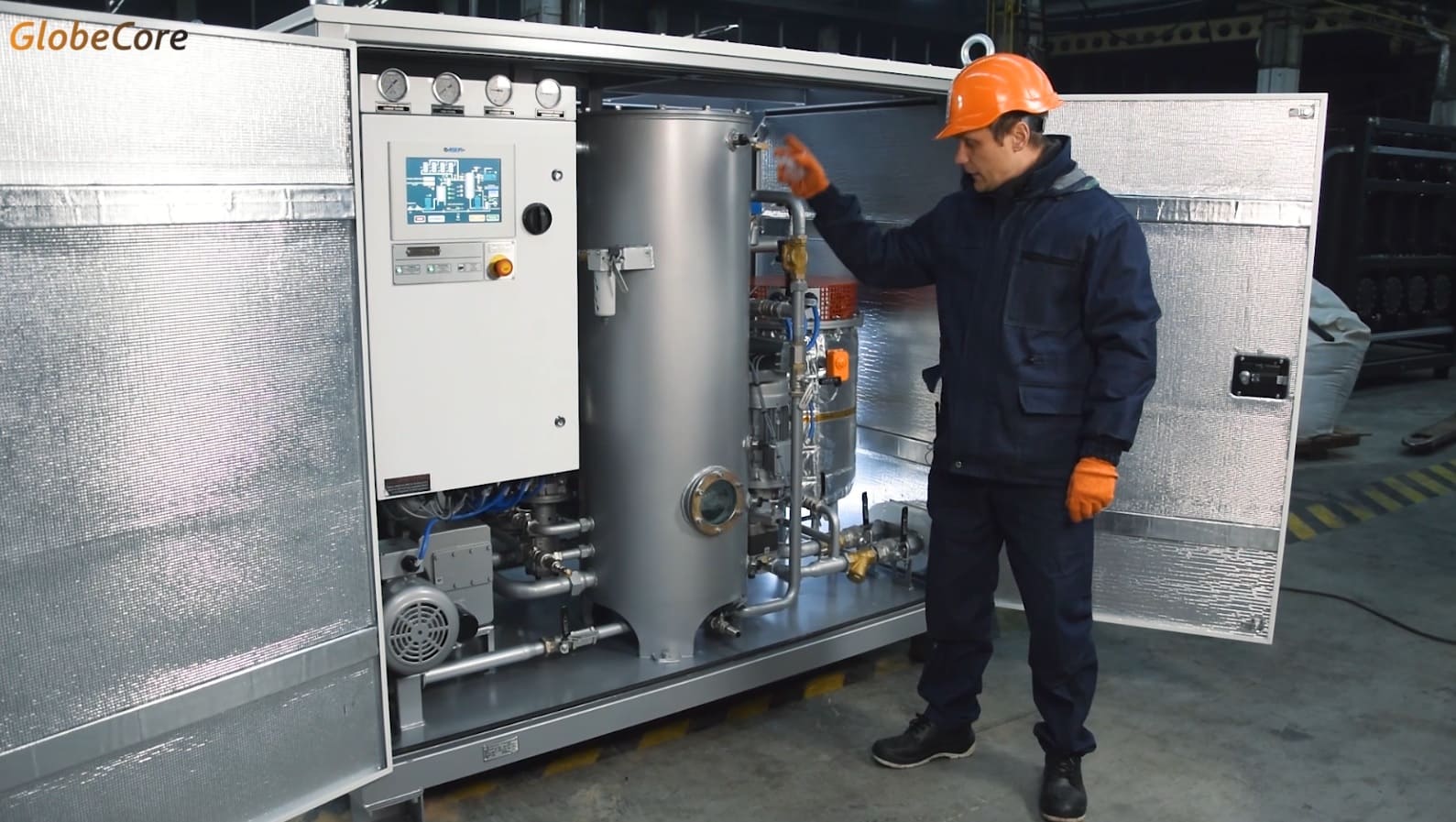
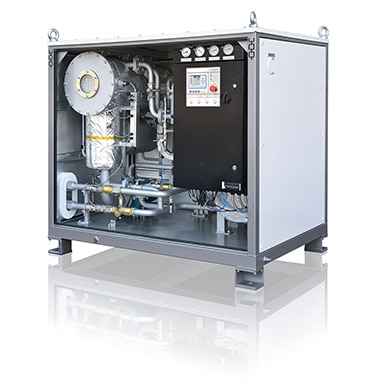
This is why integrated oil purification units have gained attention in recent years. They are designed as complete systems, where several purification stages are arranged in a single process flow, making oil treatment more predictable and easier to control. The photo below shows an example of such a turbine oil purification unit, illustrating how these technologies are implemented in an industrial setup rather than just in theory.
Attachments:
-
February 13, 2026 at 1:03 pm by Sonia Patel
You’re right — real-world effectiveness comes from how methods are sequenced and integrated. Modern turbine oil purification units combine heating, vacuum degassing, fine filtration and adsorption polishing in a single process flow so moisture, dissolved gases, particulates and ageing by‑products are addressed together rather than in separate, disruptive steps. A typical CMM‑series style unit (like the CMM‑4T shown) uses a heater to lower oil viscosity and release dissolved water, a vacuum chamber to remove free and dissolved moisture and gases, cartridge filtration (typical 3–4 µm media) for solid contamination control, and adsorbent columns to capture oxidation products and neutralize acids; automation and touch‑panel control let these units run as continuous in‑line or bypass polishers for routine conditioning with minimal shutdowns.
For practical operation, run the purifier in continuous or periodic bypass to keep particle count, water ppm and TAN within target limits, and use adsorption/regeneration modules (or sorbent reactivation capability) to extend consumable life. Be realistic about limits: integrated purification restores physical and most chemical properties but can’t fully replace depleted additive packages, so monitor water content, particle count, TAN and dielectric properties and plan partial oil replacement or additive replenishment when lab results indicate. For long‑term turbine oil reliability, choose a unit sized for expected flow/viscosity range, include vacuum dehydration and adsorption stages, and integrate automated monitoring to make conditioning predictable and maintenance-friendly.
-
April 1, 2026 at 6:53 am by Craig Price
A useful extension to this discussion is that adsorption-based regeneration (such as regeneration using Fuller’s earth) plays a fundamentally different role compared to standard purification methods. While filtration, dehydration, and centrifugation mainly remove physical contaminants and water, adsorption targets chemical degradation products that accumulate during operation, including oxidation compounds and sludge precursors.
This is important, because a significant share of turbine oil failures is associated not only with contamination, but also with chemical aging. In practice, sorbents like Fuller’s earth are capable of binding high-molecular-weight oxidation products and restoring oil properties at a deeper level, rather than merely improving its appearance or cleanliness.
Another important aspect is that modern regeneration systems allow the sorbent to be reactivated multiple times within the same process, making continuous or semi-continuous operation feasible without frequent material replacement. This improves both economic efficiency and process stability, especially in large industrial systems where downtime is critical.
Thus, in real-world applications, the most effective strategy is often not choosing between methods, but combining conventional purification with periodic or continuous regeneration to address both physical and chemical degradation mechanisms.
For a more detailed explanation of how Fuller’s earth regeneration works in turbine oil systems and why it is effective in removing oxidation products, it is worth reviewing this article: https://globecore.com/oil-processing/regeneration-of-turbine-oil-by-fullers-earth/. -
April 1, 2026 at 7:02 am by Ryan Adams
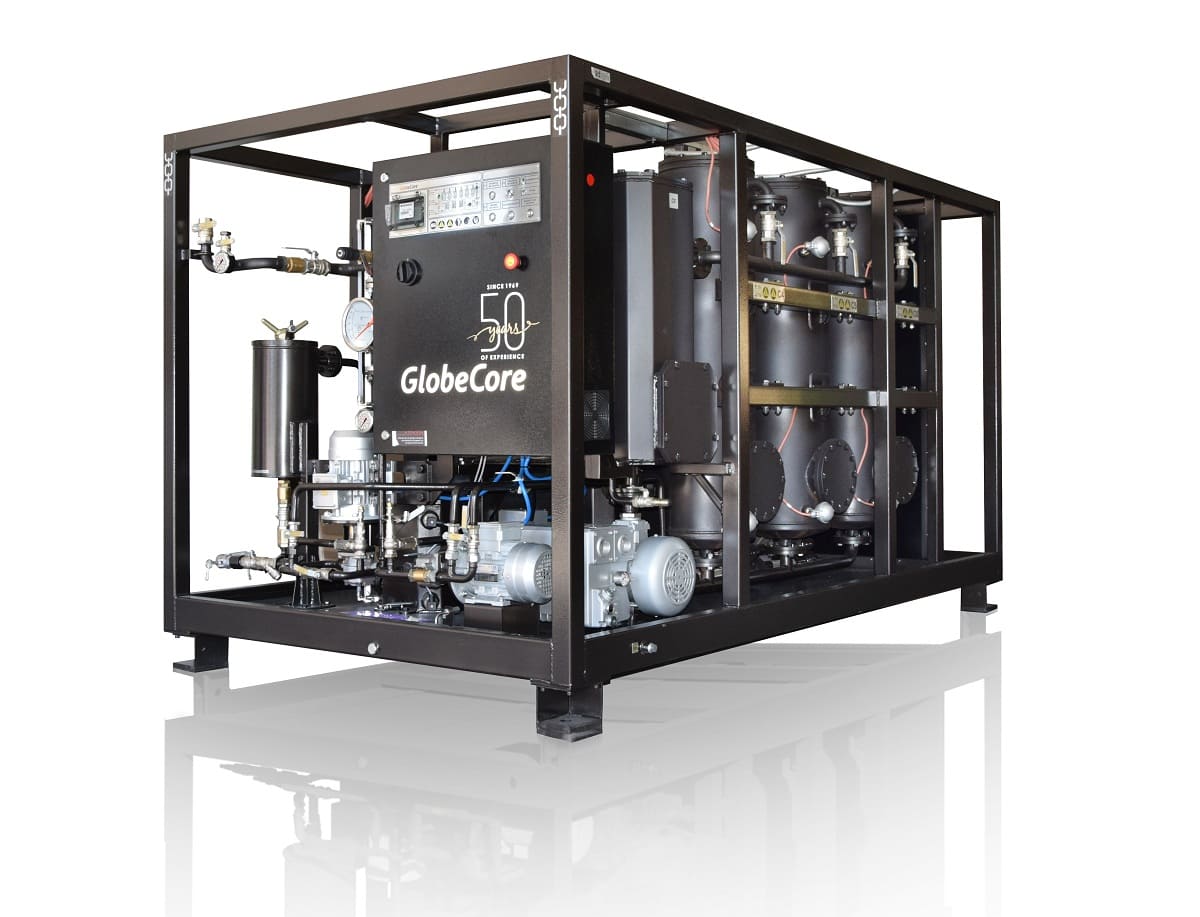
You’re correct — Fuller’s earth (adsorption-based) regeneration is a different class of treatment because it removes the chemical products of oil ageing rather than just the physical contaminants. In practice oil is first brought to the right temperature and stripped of free and dissolved water and particulates (heating, vacuum dehydration and cartridge/coalescing filtration), then passed through adsorbent columns filled with Fuller’s earth. The sorbent’s high surface area and chemisorptive affinity bind polar oxidation products, acids and sludge precursors (high‑molecular‑weight degradation products), restoring dielectric and lubricating properties that filtration/centrifugation or electrostatic separators cannot remove.
That difference is why integrated systems are most effective: a two‑stage flow (filtration/dehydration followed by Fuller’s earth adsorption) lets you treat moisture, gases and solids first, then polish chemically degraded oil to near‑new performance. Commercial units (CMM‑R family style) use multiple adsorbent columns for capacity and can reactivate the sorbent many times (often several hundred cycles), enabling semi‑continuous or bypass operation with minimal downtime. Operationally, size the unit for expected flow and viscosity, run it as continuous or periodic bypass polishing, monitor water ppm, particle count, TAN and dielectric strength, and plan to blend antioxidant/additive packages after regeneration when lab results show additive depletion, since adsorption restores oil chemistry but does not replenish spent additives.