GlobeCore

  • Home
  • Products
    • Oil Regeneration
      • CMM-6RL Oil Regeneration Unit
      • CMM-10RL Transformer Oil Regeneration Plant
      • CMM-12R Oil Regeneration Systems
      • CMM-12R Oil Regeneration System (With Activated Bauxite)
      • CMM-8RSL/4000 Transformer Oil Regeneration Plant (With Fuller’s Earth)
      • USB-6 Oxidation Inhibitor injection unit
      • СММ-0,001U Laboratory Oil Filtration Unit
    • Oil Purification & Degassing Machines
      • CMM-0.6L Oil Degassing & Filtration Cart
      • СММur-1L mobile oil plant
      • CMM-1.0LT Transformer Oil Purification Unit
      • CMM-1H Oil Processing Unit
      • CMM-2.2LT Industrial Oil Purification Unit
      • CMM-4,0T Turbine oil filtration
      • CMM-4,0LT Transformer Oil Purification Unit
      • CMM-4/7 portable oil degassing unit
      • CMM-6LT Industrial Oil Purification Unit
      • CMM-6/7 Degassing Unit
      • CMM-8LT Oil Processing Unit
      • CMM-10 — Transformer Oil Purification Machine
      • CMM-15 Oil Degassing Plant
    • Oil Filtration Machines
      • CMM-1,0CF Unit for Removal of Water from Oil
      • CMM-2,0CF Unit for Removal of Water from Oil
      • CMM-1,2Fr Industrial oils filtration unit with self-cleaning filters
      • CMM-4,0F Oil filtration unit
    • Oil Drying Unit
      • ZP-130 Sorbent Cartridges
      • ZP-260 Sorbent Cartridges
    • Oil Heating
      • PPM Inline Oil Heater. Stream oil heating
    • Fuel Polishing
      • TOR-1 diesel fuel moisture content tester
      • CMM-6RL dark diesel fuel polishing machine
      • CMM-6RL dark heating fuel polishing machine
      • CMM-6RL low-viscosity marine fuel polishing machine
    • Online Transformer Dry-Out Systems
      • CMM-260C Online Transformer Dry-Out System
      • TOR-4 Online Transformer Dry-Out System
    • Online Transformer Monitoring Systems
      • TOR-5 Online Transformer Monitoring System
    • Transformer Maintenance
      • Mojave Heat (Sukhovey): Hot Air Dryer Unit
      • UVV Vacuum Cold Trap
      • US-6S Transformer vacuum furnace
      • LFD Low Frequency Heating Device
      • BV-3000 Transformer Evacuation System
      • BV-5000 Transformer Evacuation System
      • UVD Vacuum Oil Filling Unit
      • UVD-1000 Oil Filling and Transportation System
      • TSS Transformer Safety System
      • CMM-6RL Oil Regeneration Unit
      • CMM-10RL Transformer Oil Regeneration Plant
      • CMM-12R Oil Regeneration Systems
    • Vacuum Transformer Drying Ovens
      • US-6S Transformer vacuum furnace
    • Sorbent Processing
      • ZP-130 Sorbent Cartridges
      • ZP-260 Sorbent Cartridges
    • Instruments – Transformer Oil Testers
      • TOR-1 Oil Moisture Meter
      • TOR-2 Hydrogen and Moisture Analyzer for Transformer Oil Monitoring
      • TOR-3 (TOR-3 SL) Oil Tan Delta Tester
      • TOR-6 Transformer Oil Moisture and Particles Tester
      • TOR-7 Universal Transformer Oil Tester (moisture, gases, solid particles)
      • TOR-8 tester for residual gas content of insulating oil
      • TOR-60 (TOR-60 SL) Breakdown Voltage Tester
      • TOR-80 (TOR-80 LSL) Breakdown Voltage Tester
      • TOR-80A (TOR-80 ASL) Transformer Oils Breakdown Voltage Tester with Battery
      • TOR-100 (TOR-100 SL) Breakdown Voltage Tester
    • Wind Turbine Service
      • CMM-G wind turbine gearbox oil changer (with dimensions adapted to the customer’s trailer ones)
      • CMM-G Wind Turbine Gearbox Oil Changer
      • CMM-GL Wind Turbine Gearbox Oil Changer
      • CMM-0.6L Oil Degassing & Filtration Cart
      • CMM-4,0T Turbine oil filtration
    • Medical Equipment Maintenance
      • CMM-0.6 X-ray Transformer Oil Purifier
      • AVSk-150 Hospital Wastewater Treatment Complex
    • Blending systems
      • USBL-1 Laboratory Blending System
      • USB-1 Fuel oil blending system
      • USB-5 high-speed mixing unit for production of sanitizers (0.15 – 0.3 m3/h)
      • USB-5 high-speed mixing unit for production of sanitizers (1.1 m3/cycle)
      • USB-6 Impeller Stirrer
      • Colloid Mill
      • Vortex Layer Devices
    • Colloid Mill
      • Colloid mills for food industry
        • CLM-100.3 Colloid mill
      • Colloid mills for bitumen emulsion production
        • CLM-0.25.1 Laboratory colloid mill
        • CLM-2/4 Colloid mill
        • CLM-16/25 Colloid mill
      • Colloid mills for bitumen modification
        • CLM-8/16 Colloid mill
        • CLM-10/20 Colloid mill
        • CLM-40.2 Colloid Mill
      • Colloid mills for different applications
        • CLM-100.2 Colloid Mill
        • CLM-200.2 Colloid Mill
    • Vortex Layer Devices
      • AVS-100 Mixing Machine. Vortex Layer Device
      • AVS-150 Chemical Mixing Machine
      • AVSp-100 Vortex Layer Device (Semi-Automated)
      • AVSp-150 vortex layer device (semi-automated)
      • AVSk-150 Wastewater Treatment Complex
    • Bitumen emulsion plant, Bitumen Emulsion Production
      • CLM-0.25.1 Laboratory colloid mill
      • USB-2 Bitumen emulsion unit 2 m3/hour production capacity
      • USB-2 Bitumen emulsion plant 8 m3/hour production capacity
      • FB Bitumen filter
      • USB-6 Impeller Stirrer
    • Bitumen Modification Plant. Modified Bitumen Production
      • USB-3 Bitumen modification laboratory system
      • USB-3 Continuous Bitumen Modification Unit (12 m3/hour)
      • USB-3 Bitumen modification unit 16 m3/hour production capacity
      • USB-4 Modified bitumen collection tank (USB-3)
      • USB-6 Impeller Stirrer
    • Laboratory system for Bitumen Emulsion Samples
      • CLM-0.25.1 Laboratory colloid mill
      • CLM-100.1 Bitumen Emulsion Laboratory System
      • USB-3 Bitumen modification laboratory system
    • Biodiesel Equipment
      • USB-1L Biodiesel laboratory equipment
      • USB-1 Biodiesel equipment
        • Filters
          • The filter GC Fine with a filtration factor β = 4000
        • Vacuum Pumps
          • GC Roots Vacuum Pumps
          • مضخات التفريغ GC Vane (مضخات دعم)
    • Custom Equipment
      • CMM-4R TRANSFORMER OIL REGENERATION MACHINE
      • CMM-1 MOBILE OIL PLANT
      • CMM-2.2 MOBILE OIL PLANT
      • CMM-4 MOBILE UNIT FOR POWERED TRANSFORMER OIL PROCESSING
      • CMM-12A DEGASSING UNIT
      • CMM-1CO CABLE OIL DEGASSING UNIT
      • CMM-5M INDUSTRIAL OIL PURIFICATION MACHINE
      • CMM-8RP Sorbent Reactivation Unit
      • BDK-3 CATALYTIC CONVERTER
      • CMM-600CF TRANSFORMER OIL FILTRATION AND REFILLING MACHINE
      • SN-1 PUMP ASSEMBLY
      • SBE-30 BITUMEN EMULSION COLLECTION TANK (UVB-1)
      • UVB-1 BITUMEN EMULSION UNIT 1 M3/HOUR PRODUCTION CAPACITY
      • UVB-1 EXTENSION 1 M3/HOUR PRODUCTION CAPACITY
      • INDUSTRIAL MIXER – COLLOID MILLS CLM-4 SMALL
      • BIG COLLOIDAL MILL CLM-18 GRINDING MACHINE
      • INDUSTRIAL MILL – GIANT COLLOIDAL MILL CLM-22
      • CMM-0.6 Clean Marine Oil Degassing Cart
      • Compressed Air Supply Unit UOV
    • Accessories & Components
  • Dealers
  • Tech School
    • Webinar Registration
  • News & Articles
  • History
  • Reviews
  • AskMe
  • Contacts
  • EN
    • FR
    • ES
    • PT
    • TH
    • VN
    • CN
    • HA
    • AZ
    • JP
    • DE
    • RO
    • Hun
    • Arabic
    • Ind
GlobeCore / Oil Filtration / Transformer Oil Dehydration

Transformer Oil Dehydration

transformer oil dehydration

In this article, we will describe the process of transformer oil dehydration. You will read about the danger of moisture in insulation oil, what kinds of moisture there can be and learn of the most efficient methods of removing that moisture.

The current transformer oil testing standards regulate the primary parameters and properties of the liquid, such as transformer oil colour, which is light yellow for new unused oil. With time, the color changes, which means that the quality and properties of the oil degrade. Also, transformer oil acidity test are required, as well as moisture content measurement, dielectric strength and dissipation factor tests.

Each of the parameters degrades over time when the is used in a transformer due to heavy operating loads (high temperature, high strength of the electromagnetic field etc) and presence of impurities, such as water, gas, particulate matter, sludge etc. The question is: how to return the properties of good transformer oil?

The danger of water

Water in transformer oil leads to a number of undesirable consequences:

  • – reduced dielectric strength and partial discharge stability;
  • – intensive aging of paper insulation;
  • – acceleration of oil oxidation;
  • – increased formation of carbon with electric arcing;
  • – increased corrosion of transformer metal parts caused by the oil;
  • – reduced fluidity of the oil at higher temperatures.

These can be avoided by scheduled moisture content control and transformer oil dehydration.

How water gets into transformer oil

There are two ways for water to get into the oil. The first one is the atmosphere. The second is water from the cellulose insulation and the oil, which appears due to the aging processes. If the transformer is constantly operated with full load, its insulation system will age in approximately 20-30 years. As much as 0.5-0.75% of insulation weight will be released as water during that time.

Water in transformer oil can be in one of the following forms:

  • water settled to the bottom of the cooling tank (free water). It does not influence dielectric strength, but is still undesirable, because it means that solved water is also present in the oil;
  • solved water significantly reduces the oil’s dielectric strength (it usually enters the oil from the atmosphere);
  • – bound water is one of the first indications of oil aging, being one of the results of the oil’s oxidation. At elevated temperatures due to transformer heating, bound water turns into vapor;
  • emulsified water is a mixture of transformer oil with submicroscopic water droplets, which cannot be separated from the oil by heating, settling or filtration.

Transformer oil dehydration must reduce the concentration of water to levels allowed for continued use of the dielectric fluid and to restore the oil’s dielectric strength to the required performance parameters.

Testing transformer oil moisture content

Transformer oil testing is performed for both for new product and for regenerated oil. Water content is a part of the testing is both cases.

Knowing the amount of water in the oil is indicative of its quality, and provides information on the causes of oil and solid insulation dielectric strength deterioration.

The highest allowed concentration of water in transformer oil depends on the type of equipment; on average, no more than 10-20 ppm (grams per ton) is allowed. Detecting such small amount of water is not simple, and the methods used for the testing must be highly precise and sensitive. Higher concentrations of water may cause transformer failure, so transformer oil dehydration is a mandatory measure.

Some of the most common methods of measuring the amount of water in transformer oil are:

  • KF filtration;
  • gas chromatography;
  • mass spectrometry;
  • the calcium hydride method;
  • photoacoustic spectroscopy.

Transformer oil dehydration – basic methods

Previously, the most common transformer oil dehydration processes were centrifugation and filtration. In the former case, centrifugal force separates the processed media into several layers. Centrifuges can remove only emulsified water. This is not enough, so the process is usually only used as a preliminary stage of oil purification. Besides, centrifuges are quite power-hungry.

Passing oil through filter presses also has its limitations, specifically low processing rate, the need to frequently change filter media and the contact of oil with air, which causes oxidation.

Using zeolite sorbent units significantly improves the dielectric strength of oil and the quality of transformer oil dehydration. GlobeCore manufactures the MCU type zeolite units, designed for various processing rates. This unit dehydrates the oil by passing it through a molecular sieves in sorbent cartridges filled with granulated zeolite.

Using zeolite for transformer oil dehydration has proven its high efficiency. Just one cycle through an MCU unit can improve the dielectric strength of transformer oil from 8-10 to 50 kV.

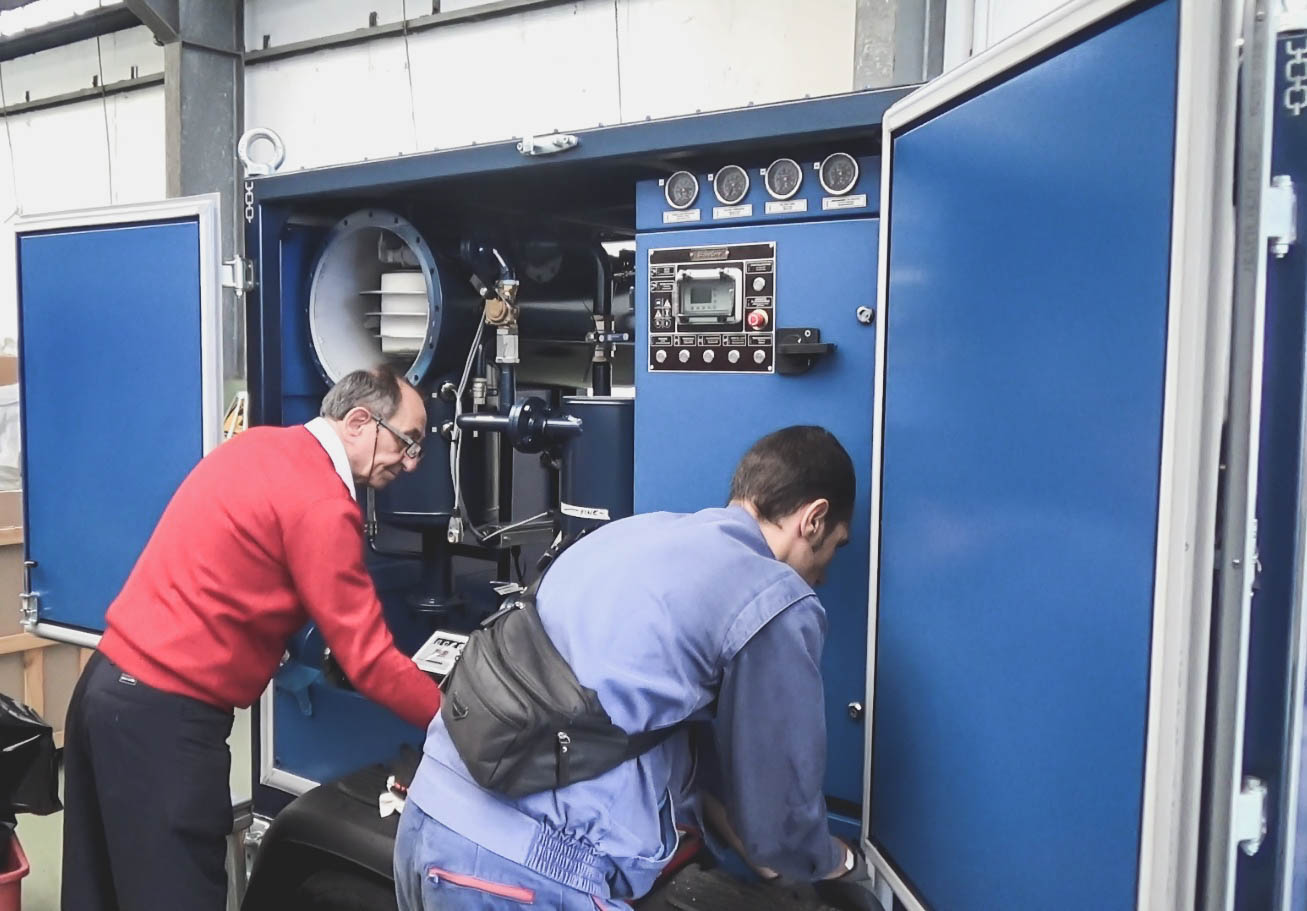
Another efficient method of transformer oil dehydration involves high temperature and vacuum. First, the oil is heated; hot oil passes into a vacuum chamber. The combined influence of temperature and vacuum causes intensive emission of water and gas from the oil, which is spread as a thin film on the surfaces inside the vacuum chamber. The heat and vacuum principle is employed for transformer oil dehydration in GlobeCore’s CMM units. This type of equipment is more efficient and reliable than centrifuges. Besides, it consumes 3-4 times less electric power.

    Leave Your Request


    • Home
    • Products
    • Dealers
    • Tech School
    • Contacts

    ® Copyright by - 2025 © GlobeCore

    GlobeCore, Sadovskogo 14, Poltava, Ukraine, 36034

    This website uses cookies to improve your experience. By continuing to browse, you agree to our use of cookies. Read more in our Privacy Policy.