

GlobeCore FAQ
I’m looking for a lab-scale colloid mill to process nut butter paste from a coarse grind to an ultra-fine grind (target particle size ~3-5 mil). What models/specs and processing setup would you recommend?
- This topic has 3 replies, 4 voices, and was last updated 4 months, 1 week ago by .
Answers
-
January 28, 2026 at 10:18 pm by Daniel Brown
For a lab-scale step from coarse nut paste to an ultra-fine 3-5 mil (~75-125 µm) grind, a small rotor-stator colloid mill is appropriate. In the GlobeCore lineup, the practical “lab/pilot” choice is a CLM-100.2 class unit (compact footprint, adjustable rotor-stator gap), run in a recirculation loop so you can make multiple passes until you hit your particle-size target without overloading the head.
-
June 1, 2026 at 7:35 am by Craig Price
One factor that is often overlooked in nut butter processing involves temperature control during fine grinding. As particle size decreases, friction inside the milling zone increases, which can affect viscosity, oil release, flavor consistency, and overall product quality. For this reason, many processors monitor product temperature closely and combine gap adjustment with multiple controlled passes rather than attempting to achieve the final fineness in a single run.
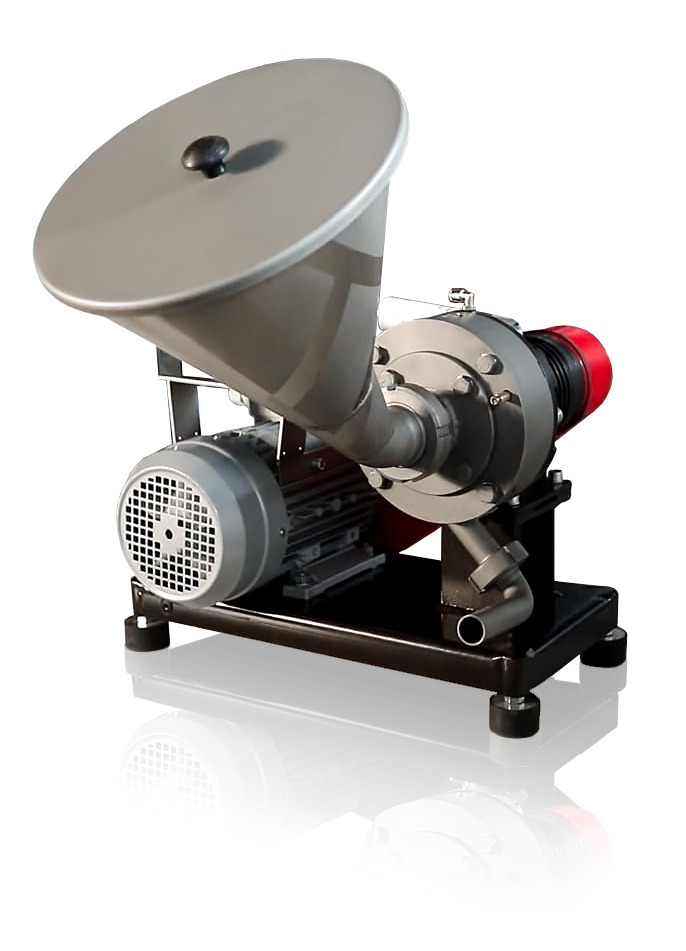
Another important consideration is the relationship between flow rate and shear forces. Increasing throughput can reduce residence time in the grinding zone, so optimizing these parameters is essential for achieving a uniform particle-size distribution and consistent texture across different feedstocks, including peanuts, almonds, hazelnuts, and mixed nut formulations. The photo below shows a CLM-100.3 colloid mill, which is an example of the type of rotor-stator equipment commonly used for fine grinding, homogenization, and texture refinement in food-processing applications.Attachments:
-
June 1, 2026 at 7:46 am by Christopher Mcdaniel
You’re absolutely right to flag temperature control and the flow/shear relationship as critical variables when pushing nut pastes to ultra‑fine fineness. Frictional heating inside a rotor‑stator colloid mill raises viscosity, drives oil release, and can alter flavor and mouthfeel, so install an inline thermocouple and monitor product temperature continuously in the recirculation loop. For lab/pilot work with peanuts, almonds, hazelnuts or mixes, keep the paste well below temperatures that promote oil separation or flavor loss — typically targeting the 30–50 °C range during fine grinding — and use a small jacketed holding tank or a plate‑heat exchanger in the loop for active cooling and PID control rather than trying to force final fineness in one pass.
Balance gap, passes and flow to control shear and residence time. Start with a moderate axial gap (mid‑range of your mill’s 0.2–2.0 mm capability) and make multiple controlled passes while gradually reducing the gap toward the 0.2–0.5 mm region to approach your 75–125 µm (3–5 mil) target; this staged approach limits head overload and excessive heat. Lower throughput increases residence time and effective shear per pass, so run nearer the lower end of the mill’s lab flow range and use the recirculation pump to tune cycles — but don’t undersize flow so much that you create dead zones or inconsistent particle‑size distribution. Watch motor torque and temperature as your primary process limits, swap rotor/stator/nozzle tooling or the replaceable knife kit for harder or oilier feedstocks, and confirm fineness with periodic sampling (microscopy or laser diffraction) plus sensory checks. The CLM‑100 series rotor‑stator machines shown in your photo are exactly the type of equipment to implement this controlled, closed‑loop strategy for reliable, uniform nut‑butter texture refinement.