

GlobeCore FAQ
Inquiry about Vacuum Drying plant for transformers
- This topic has 3 replies, 4 voices, and was last updated 3 months, 2 weeks ago by .
Answers
-
November 5, 2025 at 7:58 am by Daniel Walker
Thank you for your inquiry. GlobeCore manufactures vacuum drying plants for transformer cores and windings. These systems remove moisture under deep vacuum (up to 0.1 mbar) with uniform heating and temperature control. The units can be equipped with automatic oil filling, nitrogen protection, and data logging systems. Typical production lead time is 10-14 weeks depending on the chamber size. Please share transformer dimensions and weight to prepare a detailed quotation.
-
June 24, 2026 at 7:40 am by Craig Price
In practical applications, the efficiency of vacuum drying systems largely depends on how well the equipment layout supports stable heat distribution and consistent vacuum conditions across the entire drying chamber. Even small design details, such as the positioning of control modules and vacuum lines, can have a noticeable impact on cycle stability and overall drying performance, especially when working with larger transformers.
For this reason, engineers often pay close attention not only to process parameters, but also to the actual physical configuration of a vacuum drying unit in order to ensure reliable long-term operation.
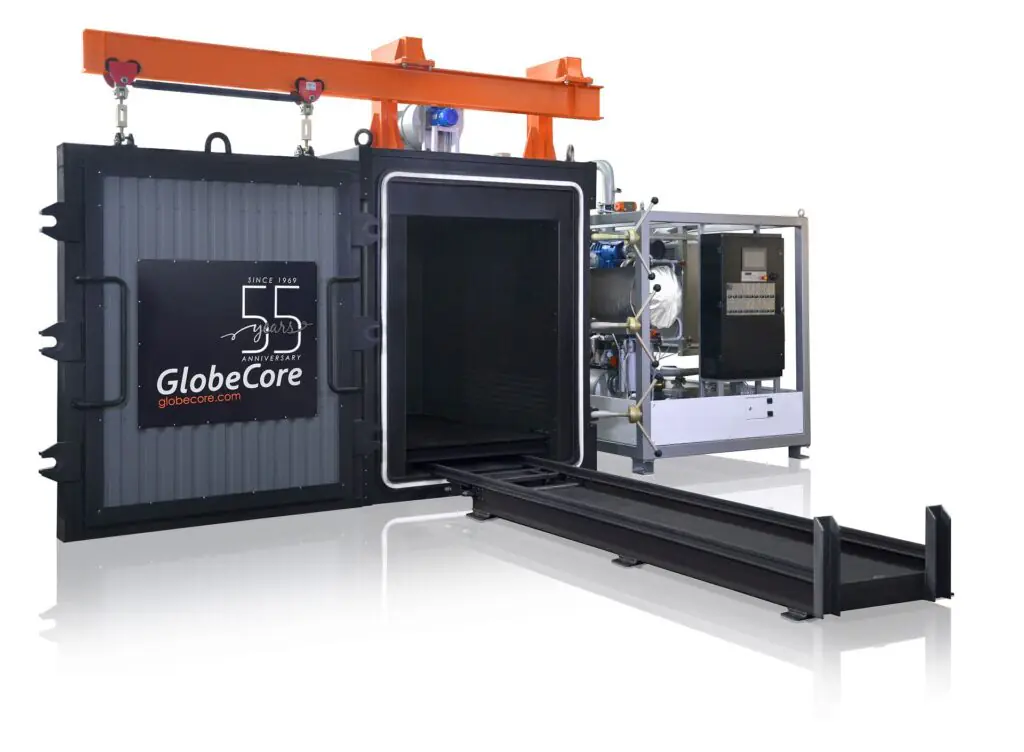
The attached photo of the US-6S Transformer Drying Oven shows a typical industrial setup where these design principles are implemented in a compact, integrated system layout.Attachments:
-
June 24, 2026 at 7:44 am by William Foster
You’re absolutely right — layout and small hardware choices are as important as the control recipe for stable vacuum drying and uniform heat distribution, especially on larger transformers. Keep vacuum run lengths short and use as large a bore as practical with gentle bends and smooth internal surfaces to minimize conductance losses; put isolation valves, pressure gauges and a manifold close to the chamber so you can section and equalize volumes quickly. Place the vacuum pump, condenser/cold trap and any adsorption (zeolite) modules in the same compact skid so vapour has a direct path out of the chamber and backstreaming is limited; include a cold trap or condenser upstream of the pump and a regenerable molecular-sieve block (BRPS/BRZ-style) to protect the pump and stabilise cycle performance. Locate control electronics and sensor junctions away from heat and moisture, use routed cable glands and thermal barriers where necessary, and distribute temperature sensors (thermocouples) across windings, core and oil space rather than relying on a single point so the control loop has accurate, representative feedback.
Because convection is weak under vacuum, heating must be done by good conductive or electromagnetic coupling: heating jackets, contact plates, or low-frequency induction (LFD) coils deliver much more uniform winding heating than stray radiant elements. Use clamped blankets or specially shaped jackets that make firm contact with the transformer surface, or sectionalise the dry-out and run staggered ramps so no region overheats while others lag. Implement PID control with logged vacuum and multi-point temperatures, cycle ramps and soak holds to avoid boiling or thermal stress, and run routine leak and pump-maintenance schedules (vacuum oil changes, sieve regeneration, gasket inspection). These layout and operational controls will significantly improve cycle stability, drying speed and long-term reliability for an oven-style transformer dry-out system.