

Bitumen Modification
What equipment is suitable for the production of bitumen emulsion products?
- This topic has 3 replies, 4 voices, and was last updated 3 weeks, 5 days ago by .
Answers
-
August 21, 2026 at 1:10 pm by Emily Jones
What equipment is suitable for the production of bitumen emulsion products, such as Prime Coat and Tack Coat, and would the CLM-16/25 colloid mill be suitable for this application?
-
August 21, 2026 at 1:17 pm by 山田 英樹
For production-scale bitumen emulsions the most appropriate equipment is a high-shear colloid mill designed for inline homogenization and emulsification. A good example is a CLM-16/25 colloid mill: it is built for continuous emulsification of bitumen, handles throughputs in the 16–25 m3/h range, works with kinematic viscosities around 150 mm2/s, and is rated to about 150°C and 10 bar. Its rotor–stator/nozzle tooling and replaceable knife kit give the shear and dispersion control needed for road‑grade emulsions, so it is well suited to produce Prime Coat and Tack Coat formulations when you run your specific recipes through the unit.
For smaller scale or recipe development you’ll want a lab mill (e.g., CLM-0.25.1) and a pilot/small production model (CLM-2/4) before scaling to larger CLM models. GlobeCore also offers complete USB‑2 bitumen emulsion units (2 m3/h and 8 m3/h variants) and full emulsion plant configurations if you need a turnkey solution. Select the model based on required throughput, feed viscosity and temperature, and whether you need inline continuous production or batch/pilot capability; start with lab trials to nail shear, surfactant and water ratios, then scale to the appropriate CLM or USB unit for production.
-
September 10, 2026 at 12:06 pm by Craig Price
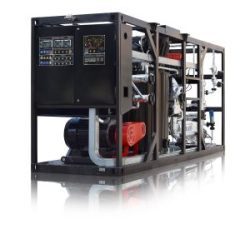
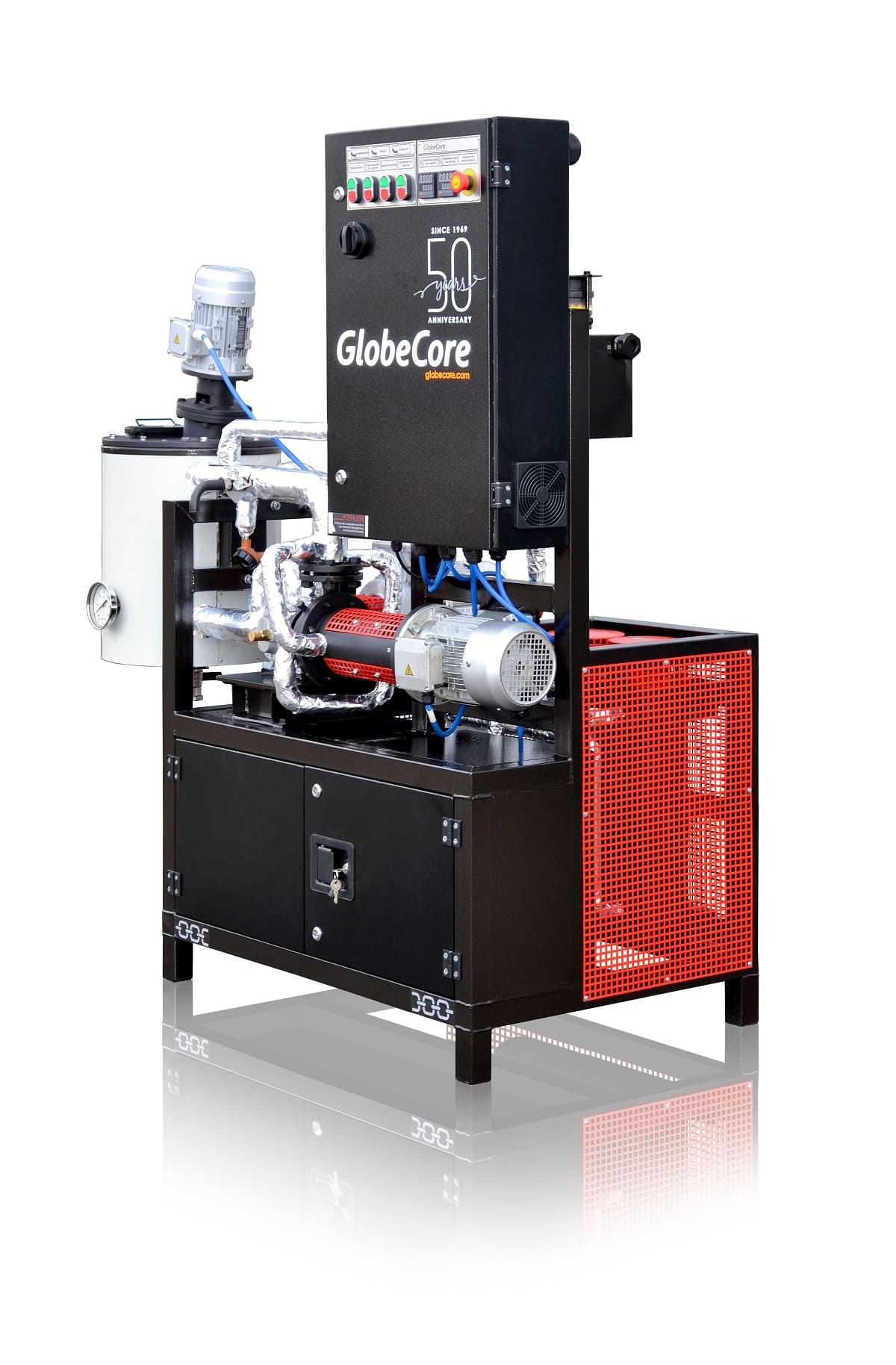
In the production of bitumen emulsion materials such as Prime Coat and Tack Coat, GlobeCore recommends using equipment designed for intensive dispersion and continuous preparation of stable bitumen emulsions. The main industrial solution is a USB-2 bitumen emulsion plant, which is intended to produce various types of bitumen emulsions with consistent quality and controlled parameters.
A CLM-16/25 colloid mill is suitable for this application and can be used as the main dispersing unit in a bitumen emulsion production line. Its high-shear rotor-stator system provides efficient mixing of bitumen, water, and emulsifying components, ensuring fine particle size distribution and stable emulsion properties.
A CLM-100.3 laboratory colloid mill would be helpful equipment in laboratory research and formulation development, while industrial production can be performed with the CLM-16/25 or complete USB-2 systems depending on the required capacity and process configuration. -
September 10, 2026 at 12:11 pm by David Allen
Your summary is on the right track: a high‑shear colloid mill is the correct dispersing tool for Prime Coat and Tack Coat production and a USB‑2 emulsion plant is the recommended industrial platform for continuous, controlled production. One point to note: the readily available industrial colloid models typically cited for this application include CLM‑8/16, CLM‑10/20, CLM‑40.2, CLM‑100.2 and CLM‑200‑2, while laboratory options are CLM‑0.25.1 and CLM‑100.1. The USB‑2 line is offered in capacity variants (e.g., 2 m3/h and 8 m3/h) and is intended to work with a colloid mill as the final emulsification stage to produce CRS, CMS, CSS‑1/2 and anionic counterparts with stable particle size and reproducible properties.
For practical planning, use a lab colloid mill for formulation work and scale to a pilot or production mill that matches your target throughput and feed viscosity. If you need a compact continuous plant, the USB‑2/2 suits small commercial batches and the USB‑2/8 suits higher throughputs; pair either with an appropriately sized CLM for final homogenization. If you tell me your target hourly throughput, the bitumen viscosity or temperature range, and the emulsion grade (CRS, CMS, CSS‑1/2 or anionic), I can recommend the exact CLM/USB combination best suited to your process.